



Radiocarbon calibration of the Inca State chronology
Head: Dr Dominika Sieczkowska-Jacyna
Duration: 2024-2027
Financial support: National Science Centre, Poland, grant UMO-2024/52/C/ST10/00061
Dissemination of scientific results
Articles
Events
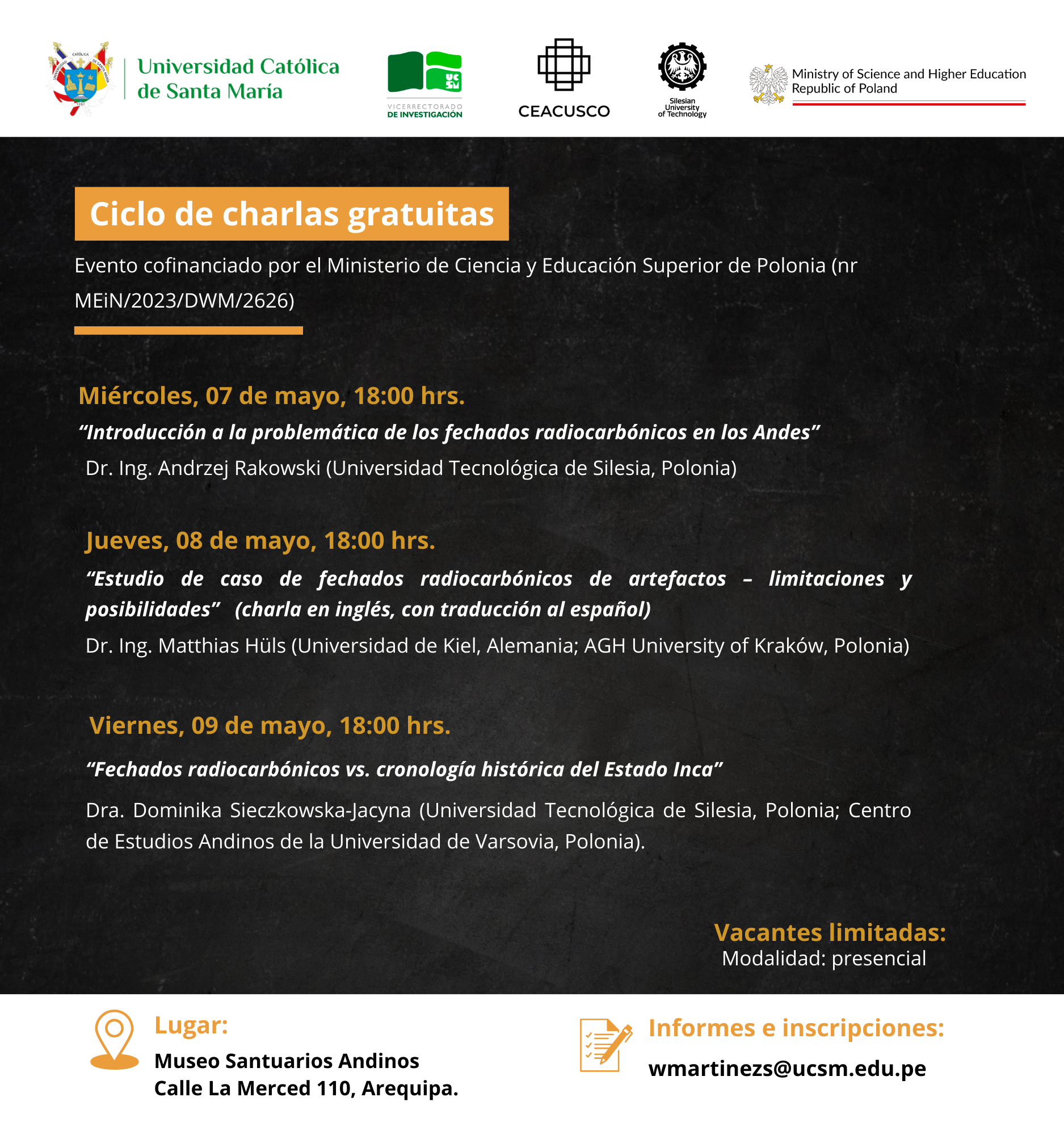
- Seria wykładów w Arequipie (Peru) Ciclo de charlas gratuitas sobre el radiocarbono w dniach 7-9 maja 2025 https://ceacusco.com/wp-content/uploads/2025/05/Curso.png
- Warsztaty na Cornell Institute Of Archaeology And Material Studies (CIAMS) 7 listopada 2025 https://events.cornell.edu/event/ciams-workshop-dominika-sieczkowska-jacyna
- Seminarium Chronologii Andyjskiej w Warszawie 15 grudnia 2025 https://ceacusco.com/wp-content/uploads/2025/12/seminarium-chronologiczne-harmonogram.pdf
Abstract
The project seeks to accurately reconstruct the timeline of events during Tawantinsuyu's peak, the Inca Empire, employing radiocarbon dating and dendrochronology. This era spans from the late 14th century until the Spanish arrival on the Peruvian coast in 1532. Despite its relatively recent position in history, we lack comprehensive written records about the Incas. Spanish chroniclers' accounts, which aimed to piece together Inca history, lack sufficient accuracy. Recent archaeological and radiocarbon findings suggest that many hypotheses based on ethnohistorical data need revision. Radiocarbon dates from Inca provincial regions (Ogburn 2012; Marsh 2017; Ziółkowski 2020) reveal errors in the chronicles' calculations of the Inca expansion periods. While ethnohistorical estimates placed the start of imperial expansion after 1438 (Rowe 1945), research near Machu Picchu suggests it may have begun nearly fifty years earlier.
The project's main goal is to refine the timeline of Inca state development. Creating floating chronologies for the Inca period is a core part of the project, offering a foundation for wider chronological studies of the pre-Columbian era. Achieving this would enable the development of short chronological sequences tied to specific archaeological contexts and key historical events, interpreted in light of current knowledge of Inca history. Additionally, the project will consider chronicler accounts describing the expansion of the Inca into other regions of the Andes, especially during the reigns of Pachacuti Inca Yupanqui, Topa Inca, and Huayna Capac (Rowe 1945).
Research methodology
The project will analyze radiocarbon dates derived from dendrochronological studies of selected Inca wooden artifacts. The goal is to assess if it is possible to achieve sufficiently precise dating of the Inca period. Currently, radiocarbon methods provide dates with an accuracy of about ±15 years, which is inadequate for tracing the Inca expansion's dynamics. As a result, efforts will focus on developing a dendrochronological scale to better understand the transformations and changes during the Inca imperial period.
The project involves analyzing wood residues from archaeological sites in southern Peru's Cusco and Arequipa regions. These analyses will be supported by radiocarbon dating of short-lived species found in the same contexts. The archaeological contexts studied stem from excavations linked to the Incas' presence in the area. The study will include wooden structural components, ceremonial objects, and short-lived remains like grass or food residues left by the Incas. For wooden remains, the wiggle-matching method will be attempted to achieve accurate radiocarbon dates, which will then be refined using Bayesian modeling.
Standard chemical pre-treatment will be applied to various sample types, such as plant material, bones, and leather, to determine radiocarbon concentrations using an AMS system with several sequential stages. The process involves four main steps: preliminary chemical preparation, sample combustion, carbon dioxide purification, and graphitization. The cathodes produced will be analyzed at the AMS laboratories in Europe or the USA. In contrast, samples intended for stable isotope studies will be studied at the Silesian University of Technology in Gliwice.