

Author: Paweł Skóra Published at: 20.05.2026 Last update: 20.05.2026


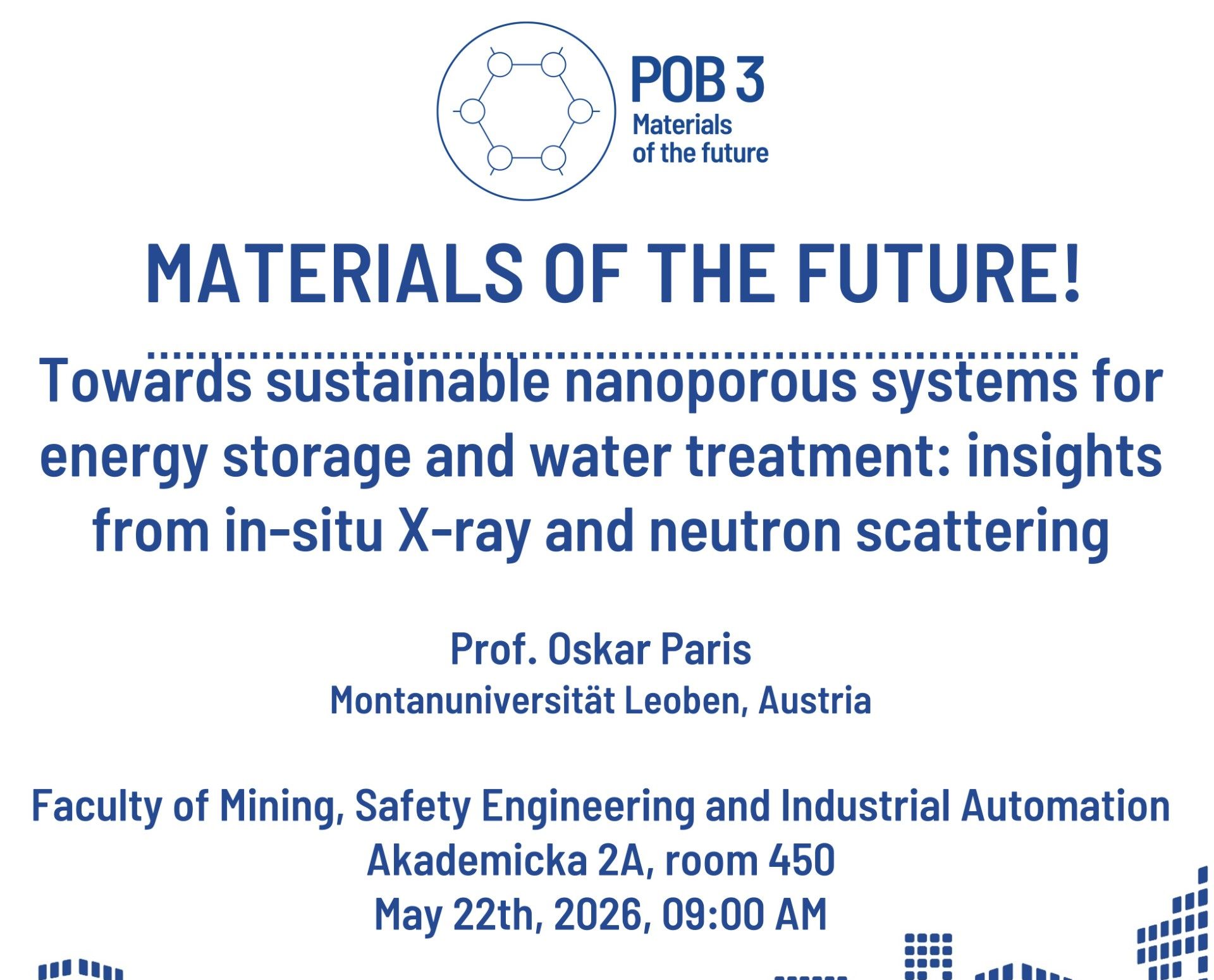
POB 3 Seminar: Visit of Prof. Oskar Paris, Austria
Dear Sir or Madam,
I would like to cordially invite you to a scientific seminar organized within POB 3, during which a lecture will be delivered by the distinguished scientist
Prof. Oskar Paris (Chair of Physics, Department of Physics, Mechanics and Electrical Engineering, Montanuniversität Leoben, Austria).
Prof. Oskar Paris (Chair of Physics, Department of Physics, Mechanics and Electrical Engineering, Montanuniversität Leoben, Austria).
Professor Paris will present a talk entitled:
“Towards Sustainable Nanoporous Systems for Energy Storage and Water Treatment: Insights from In-situ X-ray and Neutron Scattering”.
“Towards Sustainable Nanoporous Systems for Energy Storage and Water Treatment: Insights from In-situ X-ray and Neutron Scattering”.
The seminar will take place in Room 450 at the Faculty of Mining, Safety Engineering and Industrial Automation on May 22 at 9:00 a.m.
Following this, another scientific seminar will be held featuring a lecture by Dr. Eng. Dawid Gajda entitled:
“Fracture Mechanics of Reservoir Rocks and Wellbore Cement in H2 Environments”, from the University of Texas at Austin (Institute for Geophysics), USA.
“Fracture Mechanics of Reservoir Rocks and Wellbore Cement in H2 Environments”, from the University of Texas at Austin (Institute for Geophysics), USA.
During the seminar, participants will also have the opportunity to present their own research topics and consult with experts. I kindly ask all interested persons to contact me directly.
Kind regards,
Alicja Kazek-Kęsik
Short Bio
Oskar Paris is a materials physicist who obtained his PhD in Solid State Physics in 1996 at the University of Vienna, Austria. Following postdoctoral positions at ETH Zurich in Switzerland and Montanuniversität Leoben in Austria, he was a group leader at the Department of Biomaterials at the Max Planck Institute of Colloids and Interfaces in Potsdam, Germany. Since 2009, he has been a full professor and the head of the Institute of Physics at Montanuniversität Leoben. Oskar Paris is internationally recognized for his experimental work on functional nanomaterials using synchrotron radiation X-rays and neutrons at large-scale facilities, including metallic-, ceramic-, and carbon-based nanomaterials, as well as biological and biomimetic systems. His recent scientific focus is on nanoporous materials, where he has contributed to the fundamental understanding and quantitative description of the physics of fluids in nanopore confinement, and also to the field of adsorption-induced deformation. He has pioneered in-situ and operando X-ray techniques for tracking the adsorption of ions in supercapacitors and related electrochemical systems.
Oskar Paris is a materials physicist who obtained his PhD in Solid State Physics in 1996 at the University of Vienna, Austria. Following postdoctoral positions at ETH Zurich in Switzerland and Montanuniversität Leoben in Austria, he was a group leader at the Department of Biomaterials at the Max Planck Institute of Colloids and Interfaces in Potsdam, Germany. Since 2009, he has been a full professor and the head of the Institute of Physics at Montanuniversität Leoben. Oskar Paris is internationally recognized for his experimental work on functional nanomaterials using synchrotron radiation X-rays and neutrons at large-scale facilities, including metallic-, ceramic-, and carbon-based nanomaterials, as well as biological and biomimetic systems. His recent scientific focus is on nanoporous materials, where he has contributed to the fundamental understanding and quantitative description of the physics of fluids in nanopore confinement, and also to the field of adsorption-induced deformation. He has pioneered in-situ and operando X-ray techniques for tracking the adsorption of ions in supercapacitors and related electrochemical systems.
Newsy
Show all




Show more