


Start - Aktualności - The Silesian University of Technology has signed an agreement with Central Forensic Laboratory of the Police

The Silesian University of Technology has signed an agreement with Central Forensic Laboratory of the Police
Practical education, joint research projects and contact with experts – these are the most important elements of cooperation between the Silesian University of Technology and the Central Forensic Laboratory of the Police. The university has signed an agreement that aims to further combine academic knowledge with the experience of practitioners.
The agreement is an important step in the development of the Engineering Technologies in Forensic Science program at the Faculty of Biomedical Engineering. As emphasized by the Rector of the Silesian University of Technology, Prof. Marek Pawełczyk, cooperation with institutions related to professional practice is crucial to providing students with a comprehensive education.
- I am very pleased that we were able to conclude an agreement that will enrich education at the Faculty of Biomedical Engineering, and above all in the field of Engineering Technologies in Forensic Science. The Central Forensic Laboratory is an important partner that can support us in implementing this field. This is a demanding field of education that cannot be conducted on its own. Even the best university needs cooperation with partners such as the police, fire department, Medical University, or the forensic laboratory. It is this complete set of partners that allows us to provide students with the highest level of education and provide them with comprehensive, practical knowledge. Thanks to this, they will be able to acquire competences that will prove very valuable in the future job market, - says the Rector.
In the educational process, the Silesian University of Technology attaches great importance to students gaining practical experience from the first years of their studies. Contact with experts and representatives of external institutions allows students to learn about the realities of their future profession and better understand the application of the knowledge they acquire.
- We are constantly looking for contacts with the socio-economic and business environment that are relevant to a given field of study. We want to not only provide students with the appropriate competences but also interest them in the field from the first year. Contact with the world of practice and outstanding specialists allows them to better understand the purpose of their studies and maintains their motivation - emphasizes the Rector.
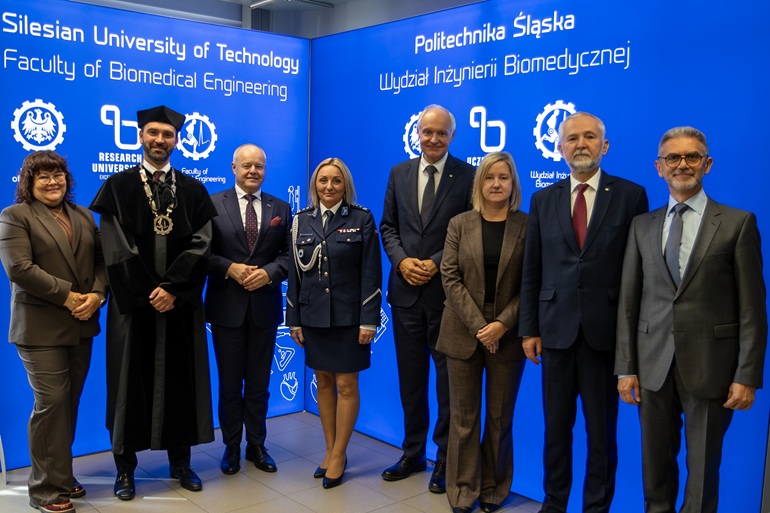
The field of study: Engineering Technologies in Forensic Science is very popular. As noted by the Dean of the Faculty of Biomedical Engineering, Dr Hab. Eng. Marcin Basiaga, Prof. SUT, the signed agreement is to be another impulse for the development of the field.
- We have been offering the Engineering Technologies in Forensic Science course since 2025 and it is very popular. We care about its further development, which is why we are consistently looking for partners who can enrich the process of education with practical experience. The Central Forensic Laboratory of the Police is, in my opinion, the best partner for such cooperation, says the Dean.
The collaboration will open up new opportunities for students to gain experience and develop their research interests. The plans include joint projects and classes led by experts from the Central Forensic Laboratory.
- This cooperation will include many different activities. It will also provide for seminars and cooperation with student science clubs. I believe that this will truly be a milestone in the development of our program, emphasizes the Dean.
“Engineering technologies in forensics” is one of the few fields of study in Poland that allows students to obtain an engineering degree in this field.
- Engineering technologies in forensics is a field of study that is intended to prepare future specialists to support forensic activities, as well as to search for new solutions and tools that can help detect and identify perpetrators of crimes - notes the Dean.
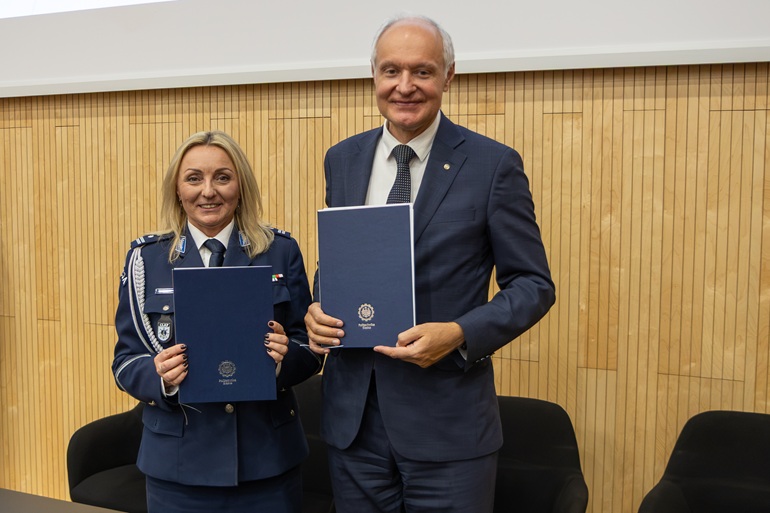
From the perspective of the Central Forensic Laboratory, cooperation with universities is an opportunity to prepare future specialists for actual work in the profession.
- We want to properly guide young people already at the stage of their studies and show them what forensics is like in reality - and not as it is presented in TV series, where solving a case often comes down to working in one room - emphasizes the director of CLK, Insp. Iwona Marciniak-Krawczyk.
Students will be able to undertake internships and study visits in the laboratory, as well as learn about the specifics of work in specific areas of forensic science.
- We want students to be able to get to know individual specializations as best as possible. In the future, it is also possible that our experts will be the supervisors of their thesis and some of them will be created directly at the Central Forensic Laboratory - says the director of the Central Forensic Laboratory.
As he points out, cooperation between science and practice is beneficial for all parties.
- There is no practice without learning and there is no learning without practice. And thanks to this agreement, we will all enjoy tangible benefits, - he emphasizes.
Working in forensics requires not only knowledge, but also patience, perceptiveness, the ability to connect facts, and passion.
- Forensic science is very difficult because it is a job that requires patience, divisibility of attention, combining facts, analysis, and passion - says the director of CLK.
At the same time, as the director of CLK emphasizes, for people who find their passion in criminology, it can become more than just a profession.
- If someone catches the criminology bug, this passion stays with him for a long time. You don't actually leave forensics - even if a department or unit changes in the police, forensics still remains at the heart of it - sums up the Director of the Central Forensic Laboratory.