



Start - Aktualności - The CYBEREDU project has begun! Experts from all over Poland are trained at the Silesian University of Technology

The CYBEREDU project has begun! Experts from all over Poland are trained at the Silesian University of Technology
On September 2nd, 2026, the CYBEREDU project called: "Improving cybersecurity competences of staff at universities, research and scientific institutes” was officially launched. The project is carried out by the Silesian University of Technology as part of a task commissioned by the Minister of Science and Higher Education.
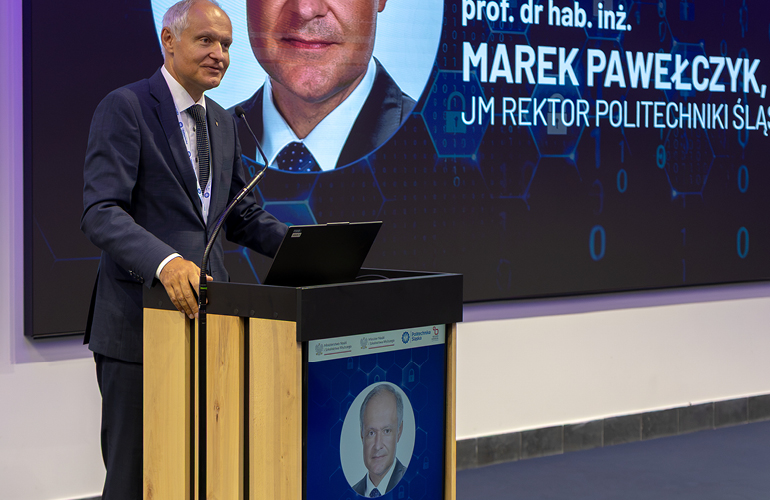
- The legal regulations that came into force this year introduced very significant obligations for universities and a great deal of responsibility for university authorities, which is why it was necessary to organize a central strategy that would prepare staff for these challenges - said Prof. Dr Hab. Eng. Marek Pawełczyk, the Rector of the Silesian University of Technology. - I am glad that the Silesian University of Technology, in cooperation with the University of Silesia, has been entrusted with this task of creating a system that will enable the implementation of an action plan in the event of cyberattacks and will train staff in both technical and management aspects - he added.
The CYBEREDU project is a response to new legal, organisational, and technical requirements resulting from the provisions on the national cybersecurity system, including the implementation of Directive (EU) 2022/2555 of the European Parliament and of the Council, known as the NIS2 Directive. The aim of the project is to support entities of the higher education and science system in preparing to perform duties related to cybersecurity management, risk management, ensuring business continuity, responding to incidents, and building and maintaining an Information Security Management System.
- As part of the project, we will train 300 people – employees of various levels from universities across Poland. These are mainly cybersecurity experts, but in the next stages of the project, administrative staff, and students, as well as university management staff, will also undergo training, explained Dr Hab. Eng. Paweł Kasprowski, Prof. SUT, the project manager.
The project initiators emphasize that the project will enable the development of cybersecurity management procedures that will be applicable in all units.
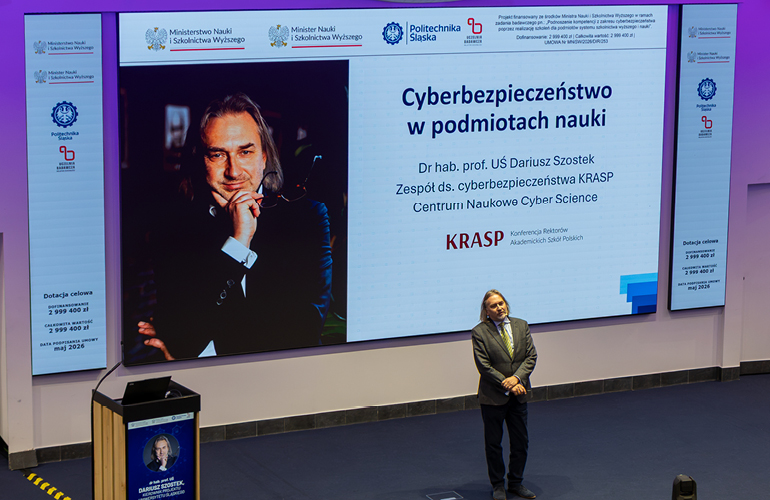
- Who will train us better if not ourselves, in universities. In addition to training, the project includes a series of elements, including preparing a report on cybersecurity in higher education and guidance on what needs to be changed. The next part, concerning education and improving qualifications among specialists at universities, aims to create a network of cyber experts in such a way that they get to know each other and the methodology that we are jointly developing in the academic environment – explained Dr Hab. Dariusz Szostek, Prof. of the University of Silesia
The project received financing from the Ministry of Science and Higher Education.
- I would like to thank the Rector for taking on such an important and enormous challenge as organizing cybersecurity training. Universities are key to our cybersecurity ecosystem, and also crucial to national security. These are places that require special care and protection when it comes to the security of research, research data, but also the security of student and university employee data – said Dr Eng. Michał Doligalski, Director of the Department of Innovation and Development, Ministry of Science and Higher Education:
- We will look at the extent to which universities should be supported in this area. For now, I can only wish the training participants to gain new useful knowledge and inspiration, - he added.
On the first day of training within the project, the participants and guests had no doubt that the higher education and science sector is a very important element of the country's cybersecurity. Entities in this sector process significant data resources, conduct scientific and research activities, maintain extensive IT infrastructure, carry out teaching and administrative tasks, and cooperate with domestic and foreign partners. Cybersecurity is thus becoming one of the conditions for the uninterrupted performance of public tasks, protection of research results, protection of personal data, ensuring the continuity of education and the security of the entire academic community.
- We hope that this entire section, all our meetings, will allow us to develop a common approach to cybersecurity issues in higher education in Poland. We should all look at this problem in a similar way, use similar tools, have a similar way of understanding these problems, and ideally also use the same documents and regulations. We cannot compete in the field of cybersecurity; we have to act together - admitted Dariusz Rajfura from the University of Economics in Katowice.
The training cycle that has just begun will last several months and includes six two-day sessions.
- I have the pleasure of leading the first day of training, which covers the general basics of cybersecurity, i.e. an introduction to cybersecurity. Listeners will learn what universities must do, who must do it, and why we must do it – said Dr Eng. Jarosław Homa, Rector's Plenipotentiary for Cybersecurity at the Silesian University of Technology. The next trainings will take place in Krakow, Poznań, Warsaw and Gdańsk, and will finally end in Gliwice. The trainings will be verified by tests prepared by the Polish Information Processing Society.
fot. Martin Huć