

Start - Aktualności - Smart Water Silesia at the Silesian University of Technology

Smart Water Silesia at the Silesian University of Technology
Digitization, artificial intelligence, energy efficiency and safety of water and sewage infrastructure are the main topics of Smart Water Silesia, an event that took place at the Faculty of Mining, Safety Engineering, and Industrial Automation of the Silesian University of Technology. The initiative consisted of two events: Smart Water Forum – a conference devoted to challenges and innovations in the water and sewage industry, and Smart Water Challenge – a hackathon during which students use data analysis and machine learning to search for solutions to real problems of the water sector. Smart Water Silesia connects the scientific community, industry and representatives of the water and sewage industry, creating a space for knowledge exchange and development of innovative solutions.
The Silesian University of Technology has once again become a space for the meeting of science, business, and local government. The Vice-Rector for Student Affairs and Education Prof. Anna Chrobok stressed the importance of cooperation with industry and preparing students for the challenges of the modern labour market.
- I am glad that once again the Silesian University of Technology is such a platform of meetings between business, local government, and science - she noted.
Prof. Chrobok drew attention to the role of industrial partners in the education of future engineers. Joint projects allow students to work in interdisciplinary teams, exchange knowledge and experience, and acquire skills useful in future professional work.
- An important element of this approach is project-oriented education, in which academic knowledge is combined with practice, and students already face specific problems during their studies - says professor Chrobok.
Minister Zmarzły spoke about the importance of water management in the context of the Silesian transformation. He drew attention to the links between water, mining and energy, and the challenges that will accompany the economic changes of the region.
- Water is a resource of today - he said.
As he pointed out, issues related to the drainage of areas and mines in the process of their closure are also of particular importance. In this context, security, cybersecurity, and the use of new technologies are becoming important.

The Minister also pointed to the possibilities offered by modern solutions in the field of more efficient use of resources and reduction of losses.
- Modern technologies allow us to use resources in a larger dimension, almost 100 percent, reduce losses, and this is very important today, - he said.
He also drew attention to the potential of young people who, thanks to creativity and a different perspective, can propose new ways of solving problems.
The need to combine science with business practice was discussed by the Dean of the Faculty of Mining, Safety Engineering and Industrial Automation, Dr Hab. Eng. Krzysztof Filipowicz, Prof. SUT. Among the key challenges of the modern economy, he mentioned rational use of water, infrastructure safety and energy efficiency of water and sewage systems. He stressed that meeting these challenges requires not only modern technologies, but also cooperation, knowledge exchange, and proper preparation of staff.
- The greatest value of science is revealed when knowledge is applied in practice - he pointed out.
As he explained, industry points out real needs and problems, science provides knowledge and tools, and students bring fresh insights, creativity, and readiness to seek new solutions.
A practical example of such cooperation is the hackathon accompanying the conference. Students work on models that predict electricity consumption in wastewater treatment plants using real-world industrial data.
Thanks to this, they can check how the knowledge gained during studies translates into solving specific technological and economic problems – emphasized the Dean.
The Vice-Dean for Infrastructure and Organization Dr Hab. Eng. Anna Manowska, Prof. SUT, explained that Smart Water Silesia is the first edition of this event at the Silesian University of Technology and in the Silesian Voivodeship.
- Its aim is to bring together representatives of science, enterprises, and local governments to jointly seek answers to the challenges of the water and sewage sector.
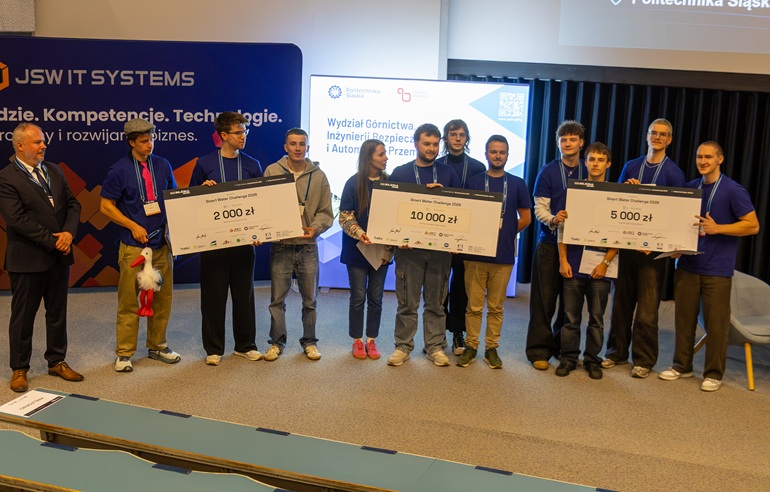
A special place in the program of the event is held by the Smart Water Challenge, a hackathon in which 11 teams took part.
- Silesian University of Technology was represented by students from several faculties: Faculty of Mining, Safety Engineering and Industrial Automation, Faculty of Automatic Control, Electronics and Computer Science and Faculty of Applied Mathematics. The event is also attended by representatives of the University of Economics and the Wrocław University of Technology – said Prof. Manowska.

The task of the teams was to search for solutions using machine learning and artificial intelligence to detect anomalies in the water and sewage sector. The organizers hope that the developed ideas will be interesting enough to be further developed and, in the future, also implemented in enterprises.
As Professor Manowska added, modern technologies can support the sustainable development of the sector by saving water and energy, predicting failures, estimating risks and planning infrastructure renovations.
The practical dimension of the project was discussed by the President of the Management Board of JSW IT Systems, Tomasz Błaszczyk, Dr in Economics. He explained that the event includes two complementary parts: a conference devoted to the challenges of the water and sewage industry and a hackathon in which students develop predictive models for the analysis of water and electricity consumption in sewage treatment plants.
- The aim is to seek new solutions by combining the creativity and energy of young people with the knowledge and experience of the scientific community and practical tools used in everyday work - emphasized President Błaszczyk.
As he emphasized, the event creates space for talks on energy management and water management, as well as on cooperation between water and sewage companies, technology companies, and the scientific community.
Beata Halama, President of the Silesian Voivodeship Water Supply Association, spoke about people who will develop and implement new solutions in water supply companies.
She pointed out that the modern water supply industry is not only thousands of kilometres of pipelines, aggregates, and fittings. It is also information technology, automation, energy, cybersecurity, and many technological systems that need to cooperate efficiently.
- I would like us, on the occasion of such initiatives, in addition to modern technologies, to talk about the people who will implement these technologies in our companies in the future - she stressed.
As she pointed out, efficient interconnection of different systems requires interdisciplinary teams and specialists able to cooperate across the boundaries of individual fields. Therefore, as important as the development of technology is the education of future staff and the promotion of the water industry among students.
She also stressed the importance of the hackathon that accompanied the event and enabled students to work on real company data.
- The fact that today’s event is parallel to a hackathon, showing the possibilities of using our current data, is fantastic. Thanks to this, solutions and projects can be created that we will be able to implement in our activities - she said.
The Smart Water Challenge, or hackathon, gave students the opportunity to use knowledge in the field of computer science, data analysis, and machine learning to solve specific problems of the water and sewage industry, and at the same time opened the perspective of practical application of the developed ideas.
Among the participants was a three-person team of Marta Załuska, Tomasz Przebindowski and Patrycja Kustra - students from the Faculty of Applied Mathematics. Students decided to participate in the event to test their own skills and face practical challenges related to the subject of the project.
- We are curious about new things. The awards were also encouraging, the topic was interesting, because it is where you can test yourself - said Marta Załuska.
The team planned to focus on data analysis and the use of machine learning methods.
- We considered, among others, forecasting energy consumption and detecting anomalies that could help companies better plan costs and identify irregularities, - said Tomasz Przebindowski.
Patrycja Kustra drew attention to the potential of data collected by enterprises. Their analysis can help to better understand processes, estimate costs and budgets, and explain changes in energy consumption.
For students, it is important not only to be able to test their knowledge, but also to create a solution that could be used outside the academic environment.
- We would love to see if this work can also be implemented in real life, - the students emphasized.
Smart Water Silesia showed how important it is to combine scientific knowledge, industry experience, and creativity of young people in search of answers to the challenges of the water and sewage industry. Discussions about digitization, artificial intelligence, infrastructure security, and energy efficiency are complemented by practical student work using industrial data.
The common goal is to develop solutions that can help companies better manage resources, reduce losses, and use energy more efficiently. Equally important is the preparation of specialists capable of implementing new technologies.
The event combines two important directions of development of the sector: technological innovation and cooperation of people from different fields. It is at their interface that solutions can be created that meet the real needs of water and sewage management.