


Start - Aktualności - Silesian University of Technology at the 29th Scientific Picnic in Warsaw
Silesian University of Technology at the 29th Scientific Picnic in Warsaw
Science that responds to real needs and changes everyday life – such solutions attracted participants of the 29th Scientific Picnic in Warsaw. A large team of Silesian University of Technology, presenting innovative technologies and research, showing how science translates into the quality of life and challenges of the modern world could not be missed among the exhibitors.
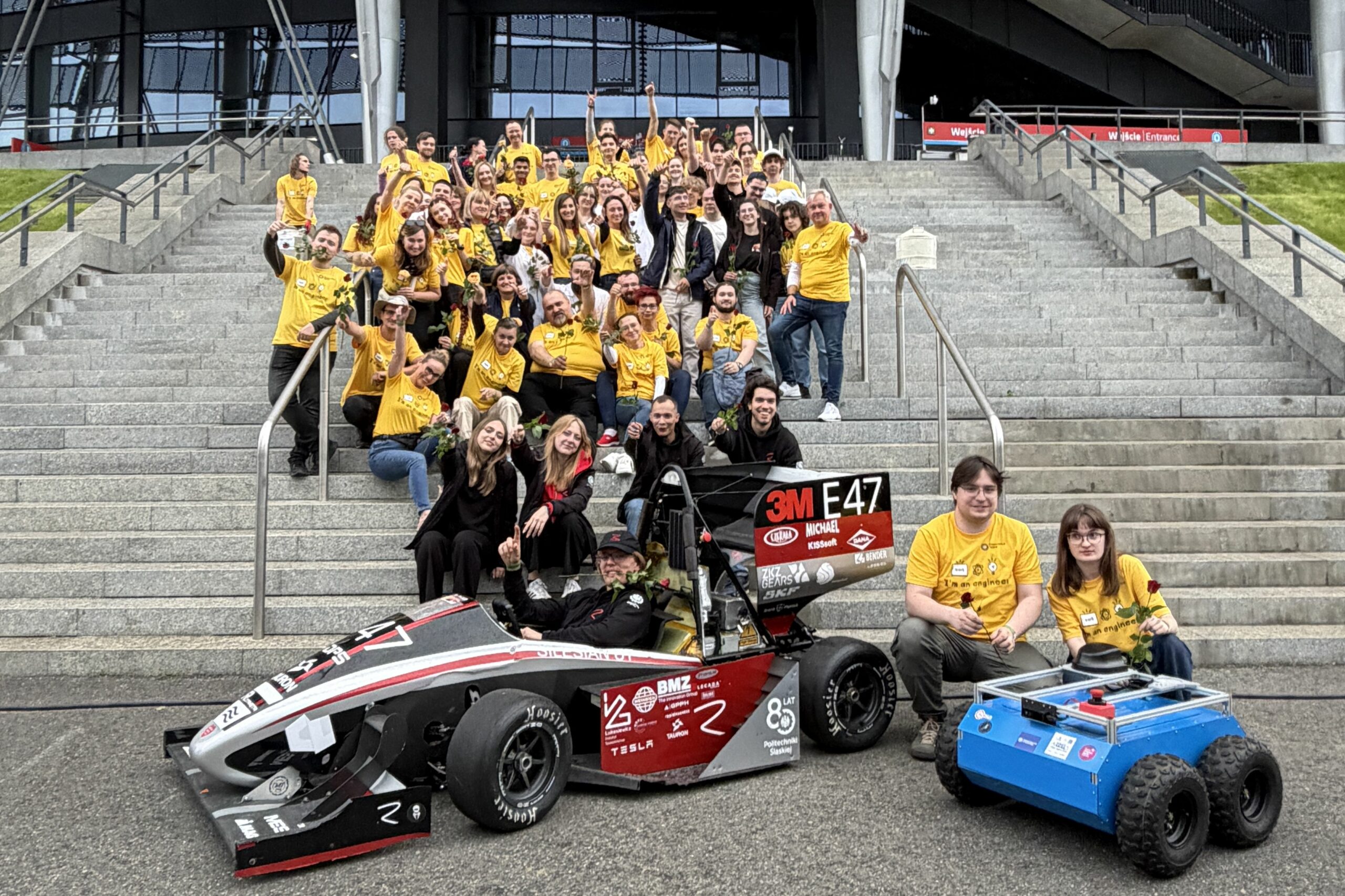
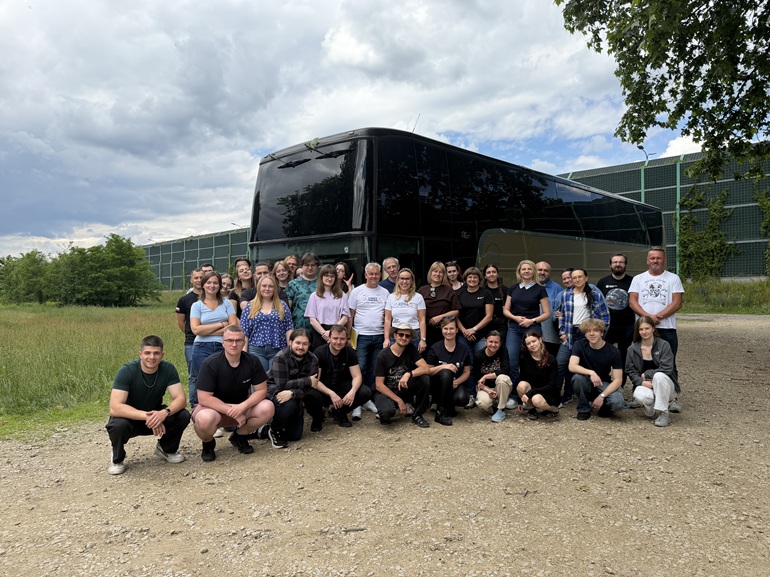
A record number of scientists, PhD students and students of the Silesian University of Technology – over 70 people – joined the representation of the Silesian University of Technology during the 29th Scientific Picnic of the Polish Radio and the Copernicus Science Centre in Warsaw under the slogan “Taken from Life”. The event is already a regular point in the popular science calendar, which attracts crowds of science lovers from all over Poland.
- Science makes sense when it goes beyond the walls of the university and meets people. At the Silesian University of Technology, we create science that changes the world, which is why it is so important to show it to the society. Our scientists prove every day that advanced research can be translated into inspiring experiences that arouse curiosity, encourage questions and build a knowledge-based future – says Dr Eng. Sandra Grabowska, Prof SUT– director of the Science Popularization Centre of the Silesian University of Technology.
Careful observation of the surrounding reality allows to see problems, needs and opportunities that turn into innovative technological and social solutions.
Such assumptions accompany projects supporting diagnostics and therapy of people with disabilities or cognitive dysfunctions. These are, among others, intelligent machines investigating reactions in the human nervous system, such as the Piórkowski apparatus and the Abilix educational robot, which was presented by a team coordinated by Dr Hab. Eng. Anna Manowska, Prof. SUT from the Faculty of Mining, Safety Engineering and Industrial Automation.
Research supporting modern techniques of diagnosis of people with cognitive disabilities and modern e-neuropsychology is also conducted by researchers from the Faculty of Electrical Engineering. - At the stand, we showed a device to study perception, to study people who have dysfunctions consisting in problems with facial recognition and colour cognition, - explains Dr Eng. Marek Kciuk. This type of diagnostic tool can be used, among others, to check for achromatopsia, a genetic defect that prevents the vision of colours.
ReXio, a robot designed by the AI-METH Student Science Club for tasks related to therapy and rehabilitation of children and adolescents was also walking along the alleys of the National Stadium.
Robotics is definitely a hallmark of the polytechnical team. Therefore, the Silesian Phoenix Student Science Club and the Phoenix III Mars rover, which is the result of the students’ daily work and passion, and above all a device with real use – from field research to rescue mission could not be missed in the Future Zone In turn, the REBOB robot is the flagship project of SKN Control Engineers. As the team members explain, it is designed for the reconstruction of 3D surroundings, as well as for unmanned missions, in places where a person could be harmed.
The Picnic participants could see how machines inspired by the flight of birds fly into the air. They could also test aircraft, gliders and drones’ control skills and perform aerial acrobatics, and a special flight simulator was prepared by a team led by Dr Eng. Wawrzyniec Panfil from the Faculty of Mechanical Engineering. Automotive fans, in turn, were watching the process of creating an electric racing car. It is a project of the PolSl Racing Student Science Club, whose members have been pioneers in activities in the field of electromobility and construction of a structure capable of competing in international competitions for years.
Scientists and students of the Faculty of Mining, Safety Engineering and Industrial Automation, members of the team coordinated by Dr Eng. Ewelina Włodarczyk and Dr Eng Aleksandra Mierzejowska, invited the viewers to the virtual reality world. VR technologies are great for mapping real-world situations and training specific skills: – With the help of VR technology, you can train first aid, bandage wounds, extinguish fires. You can also evacuate a burning skyscraper or evacuate the population in a crisis situation - says Dr Eng. Ewelina Włodarczyk.
Uczestnicy Pikniku z zainteresowaniem śledzili pokazy, dopytywali o szczegóły i z entuzjazmem reagowali na prezentowane eksperymenty. Oczywiście mogli też sami sprawdzić się w roli naukowców:
- w badaniach tajemnic molekularnego świata i odkrywaniu tajemnic DNA wraz z dr Izabellą Ślązak-Prochazką z Centrum Biotechnologii,
- w poszukiwaniu biologii wokół siebie – na przykład wśród domowych składników kuchennych; to, jak wykorzystać do eksperymentów sok z czerwonej kapusty i cytrynę, wodę z sodą czy mydło (czyli produkty o różnym pH), użyć drożdży do dmuchania baloników oraz izolować DNA z truskawek, pokazała dr inż. Magdalena Adamiec-Organiściok z Wydziału Automatyki, Elektroniki i Informatyki oraz Studenckie Koło Naukowe Inżynierii i Biologii Systemów,
- w przedstawieniu informacji biologicznej w formie niezwykłego obrazu, czyli wykorzystać fragment sekwencji DNA lub RNA i przekształcić go za pomocą aplikacji w unikalny wzór graficzny; o połączeniu biologii i informatyki opowiadali członkowie Bioinformatycznego Studenckiego Koła Naukowego.
- w zgłębianiu zjawiska dyfuzji, reakcji redoks, kwasowości i zasadowości – co było głównym tematem prezentacji Studenckiego Koła Naukowego Chemików koordynowanego przez dr inż. Annę Byczek-Wyrostek.
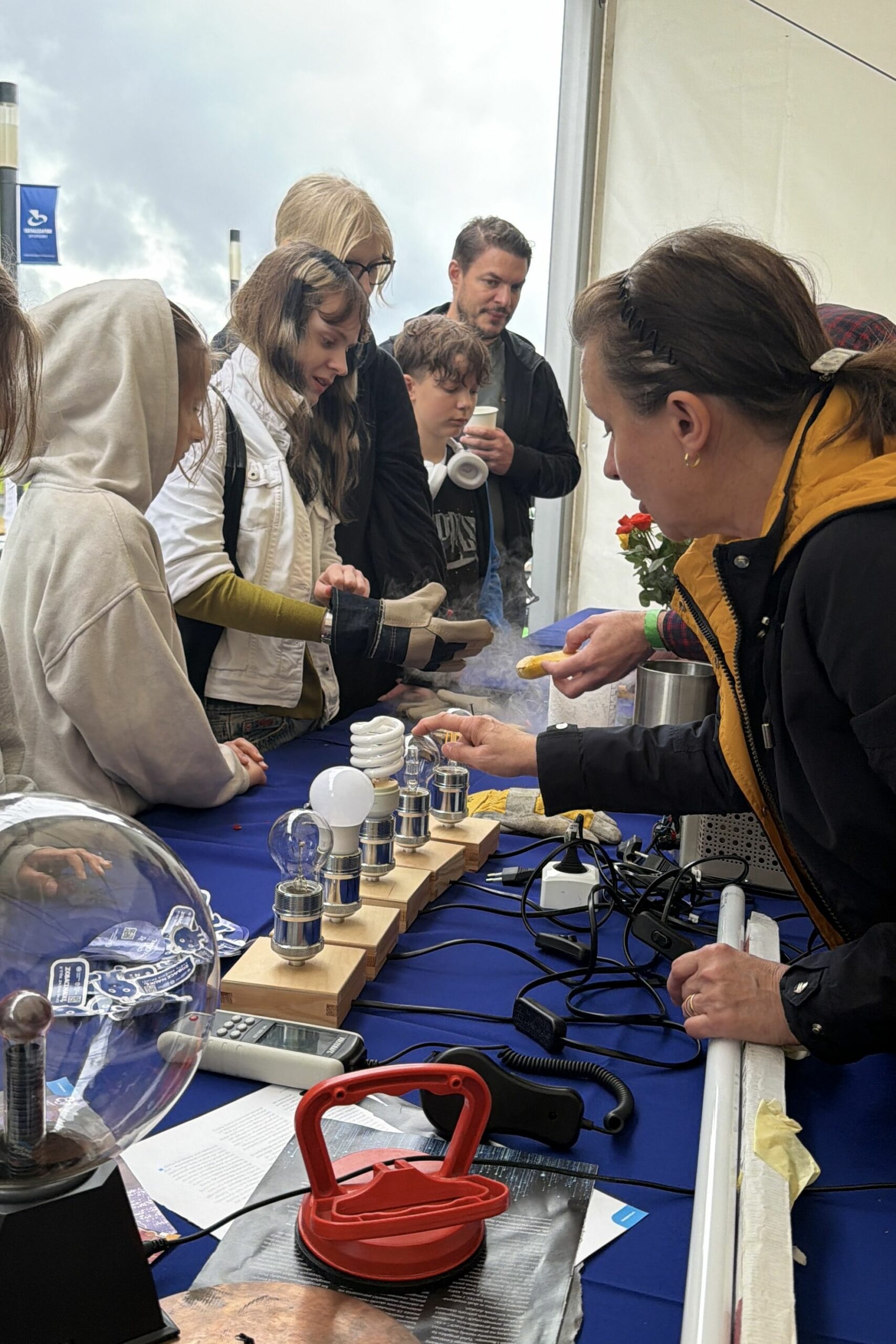
Co roku w Strefie Przyszłości przy politechnicznym stoisku można znaleźć miejsce, gdzie temperatura spada znacznie poniżej tego, co znamy z zimowych poranków. Mimo to nie brakowało chętnych, by zobaczyć, jak zmieniają się stany skupienia substancji, i zrozumieć naturę przemian fizycznych. Tajemnice niskich temperatur odkrywał prof. Jarosław Sikorski z Instytutu Fizyki – Centrum Naukowo-Dydaktycznego.
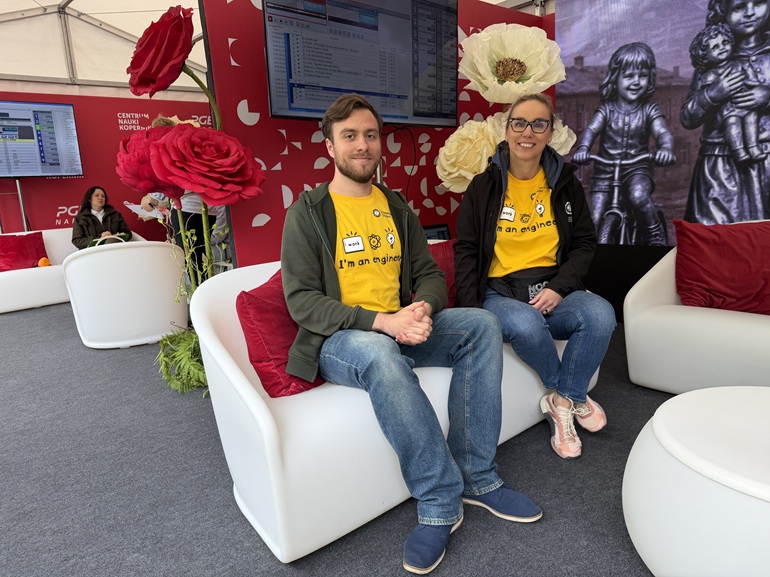
The participants of the Picnic followed the presentations with interest, asked for details and reacted enthusiastically to the presented experiments. Of course, they could also prove themselves in the role of scientists:
- In research of the secrets of the molecular world and discovering the secrets of DNA together with Dr Izabella Ślązak-Prochazka from the Biotechnology Centre,
- In the search for biology around us – for example, among household kitchen ingredients; how to use red cabbage juice and lemon, water with soda or soap (i.e. products with different pH) for experiments, use yeast to blow balloons, and isolate DNA from strawberries. This was presented by Dr Eng. Magdalena Adamiec-Organiściok from the Faculty of Automatic Control, Electronics and Computer Science and the Student Science Club of Engineering and Systems Biology,
- Members of the Bioinformatics Student Science Club talked about the combination of biology and computer science in the presentation of biological information in the form of an unusual image, i.e. using a fragment of DNA or RNA sequence and transforming it with the help of an application into a unique graphic pattern.
- In exploring the phenomenon of diffusion, redox reactions, acidity and alkalinity – which was the main topic of the presentation of the Student Science Club of Chemists coordinated by Dr Eng. Anna Byczek-Wyrostek.
Every year in the Future Zone at the SUT stand, one can find a place where the temperature drops much below what we know from winter mornings. Nevertheless, there was no shortage of people willing to see how the states of matter change and to understand the nature of physical changes. The secrets of low temperatures were disclosed to the spectators by Prof Jarosław Sikorski from the Institute of Physics - Centre for Science and Education.
Dr Barbara Solecka from the Institute of Physics - Centre for Science and Education invited the spectators into the world of physics: - I have shown phenomena based on Bernoulli’s law, the law of gas and liquid flow, and how this law is applied in our lives. It is related, for example, to the air stream, which can even draw a person in – hence the messages at the train stations “Do not get close to the edge of the platform” while the trains pass by.
Energy is a phenomenon of life, present both in living organisms, in the structure of the Earth and in nuclear processes occurring in nature. Dr. Eng. Tomasz Bury from the Faculty of Energy and Environmental Engineering with whom participants could explore phenomena such as bioelectricity, measure natural radiation, and learn about the operation of the Oklo natural reactor in Gabon, where more than two billion years ago nature itself led to a chain reaction in the uranium deposit talked about this in his presentation.
In nature you can find various traces, but to recognize them you need knowledge in the field of dactyloscopy, cheiloscopy, otoscopy, odontoscopy and traseology. What do these concepts mean? As explained by Dr Eng. Magdalena Zorychta-Tomsia from the Faculty of Mechanical Engineering, these are methods of identification of persons and traces, such as fingerprints, the shape of the auricle, the imprint of the sole of shoes, which are used by investigators, and in their analysis helps science. A lot of traces can also be found in the fossils. But this is already the role of geologists from the Faculty of Mining, Safety Engineering and Industrial Automation. At the stand prepared by a team coordinated by Dr Eng. Jacek Nowak, participants could see fossils of various marine and terrestrial organisms, as well as – using a microscope – microfossils and plant tissues preserved in coal.
While some have discovered the secrets written in fossils and learned the history of the Earth, others have seen how knowledge of the properties of rocks, minerals and land finds it practical application civil engineering. The participants were faced with building tasks – construction of a communication embankment. And although it sounds a bit complicated, scientists from the Faculty of Civil Engineering under the supervision of the coordinator of activity Dr Eng. Konrad Walotka showed that the sandcastle can have a lot in common with the road embankment. Thanks to this, the youngest participants of the Picnic were particularly eager to learn about earthworks and play.
Modern construction poses environmental challenges for scientists, and engineers increasingly choose sustainable solutions, i.e. those that combine the durability of construction with care for nature. Therefore, people visiting the stand prepared by M.Sc. Eng. Nicola Kocierz from the Faculty of Civil Engineering, were given the task of building an ecological building with the help of “eco-blocks” – a small sample of concrete, to which ingredients from nature and from “life” were added, such as straw fibres, expanded clay, sawdust or ground plastic.
The efficient implementation of 20 activities was supervised by the director of the Science Popularization Centre Dr Hab. Eng. Sandra Grabowska, Prof SUT and coordinator of the event on behalf of The Science Popularization Centre Witold Ścieszka.
– One of the most important tasks of the Science Popularization Centre of the Silesian University of Technology is to build bridges between the world of science and society. The Science Picnic perfectly shows how much such meetings are needed. It is thanks to the involvement of our scientists that visitors can see that behind every discovery there are people with passion, and behind modern technologies – knowledge that has a real impact on the world around us. This is how we realize the mission of creating and showing science that changes the world – adds Prof. Sandra Grabowska
The 29th Science Picnic of the Polish Radio and the Copernicus Science Centre took place on the 13th of June 2026 at the PGE National Stadium in Warsaw.
Text by Aleksandra Wojaczek
Photos by Roksana Poloczek