



Start - Aktualności - Scientists of the Silesian University of Technology at Repower Summit 2025 in Beijing
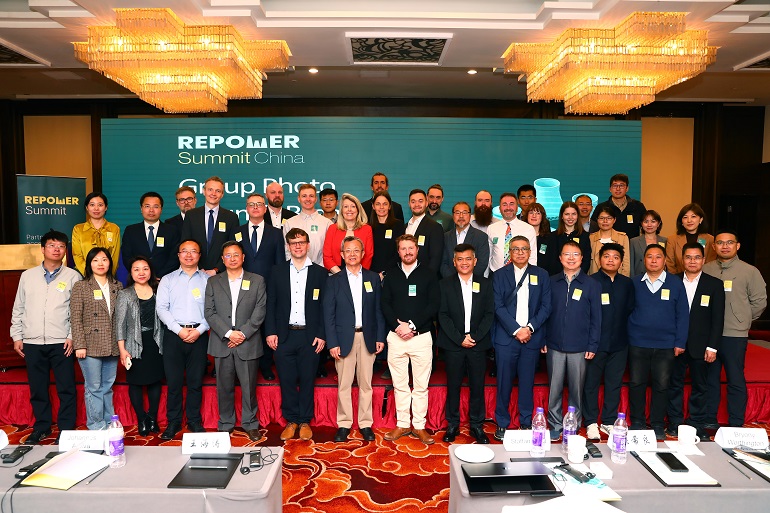
Scientists of the Silesian University of Technology at Repower Summit 2025 in Beijing
Prof. Anna Skorek-Osikowska and Dr Hab. Eng. Łukasz Bartela, Prof. SUT, took part in a six-day visit to Beijing, where, at the invitation of Tsinghua University, they participated in the Repower Summit. For several years now, this event has been gathering scientists from leading research centres, actively engaged in the development of ways of replacing coal-fired power plants by using low-emission technologies. It is worth noting that in 2025 the Repower Summit was organized by our University in the Silesian Museum in Katowice.
The main topic of the discussions held in Beijing was the coal-to-nuclear transformation path (C2N). Although this concept gained global notoriety thanks to the report of the United States Department of Energy published in 2022, as early as 2020 it was already the subject of a widely commented publication presenting the results of technical and economic analyses, conducted by a national research team in collaboration with Staffan Qvist, a Swedish nuclear engineer and a major promoter of the use of nuclear energy in decarbonization processes.
Our representatives participated both in the main activities of the conference and in numerous accompanying events, including workshops, meetings with Chinese entities interested in implementing C2N path and study visits to research and industrial facilities located in Hangzhou, Zhejiang Province. What is particularly encouraging is that the activities related to the C2N path, initiated in 2019, and developed also within the DEsire project, implemented at the Silesian University of Technology in the years 2022-2025, are in many aspects perceived by the Chinese experts as pioneering. The Net-Zero Poland project, led by Prof. Anna Skorek-Osikowska, the aim of which is to develop paths to achieve climate neutrality for Poland in 2050 also enjoyed great interest among the participants. Silesian University of Technology is the project leader, and the consortium includes Princeton University and the Institute of Energy - National Research Institute. The systemic approach to competence building for the nuclear sector, developed within the framework of the 4NEW project, led by Prof. Łukasz Bartela, was also highly appreciated. In this case, the project leader is also our University, and the consortium also includes the Ministry of Energy, the National Centre for Nuclear Research, and the University of Economics in Katowice.
The DEsire team is part of the international Repower initiative (https://www.repower.world/), under which it cooperates closely with many foreign centres, including China (Tsinghua University, Xiamen University), South Korea (KAIST), and Indonesia (Institut Teknologi Bandung).
The most important reports of the DEsire project have been translated into Chinese for the purpose of the event, and the effects are currently being analysed by experts from many Chinese industrial entities, including: China Energy Engineering Corporation (CEEC), China Energy Investment Corporation (CHN Energy), China General Nuclear Power Corporation (CGN), China National Nuclear Corporation (CNNC) and State Power Investment Corporation (SPIC).
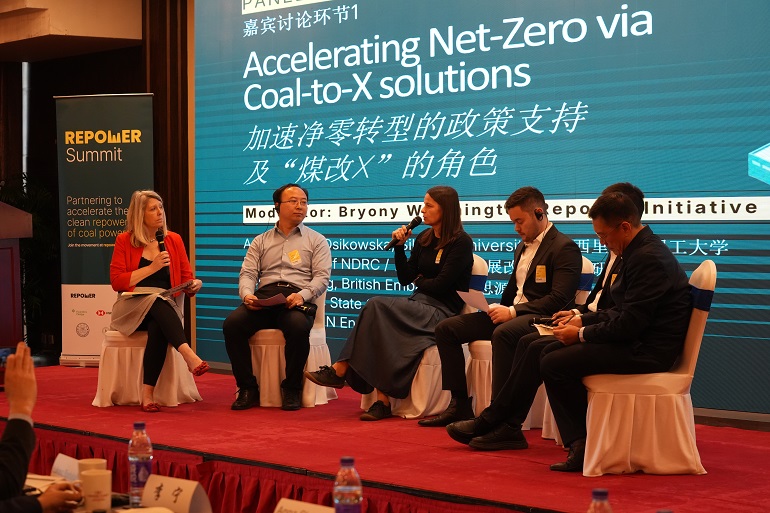
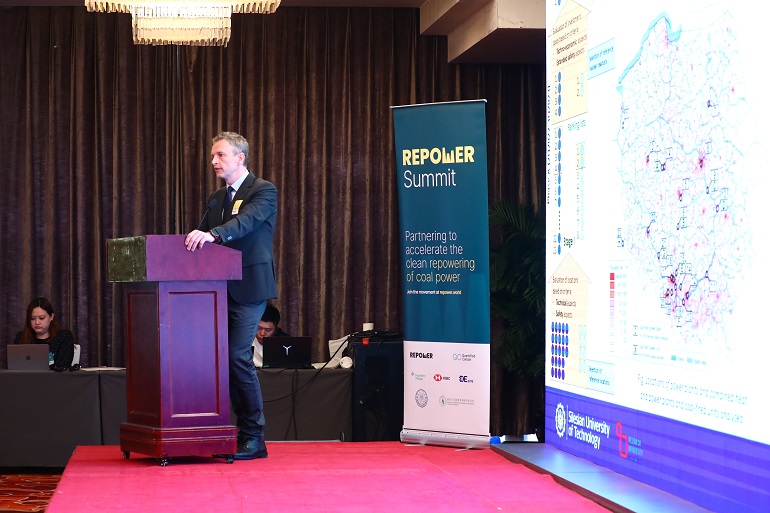
In the main part of the event Prof. Łukasz Bartela gave a speech on the subject of Energy Transition in Poland, and Prof. Anna Skorek-Osikowska took part in the panel entitled: “ Accelerating Net-Zero via Coal-to-X solutions”. In Beijing, workshops on modelling energy systems and a meeting of Repower partners were also organized, during which the directions of cooperation development and inclusion of new partners were discussed.
The presence of representatives of the Silesian University of Technology in Beijing was not only an opportunity to present the results of the work carried out, but also a confirmation of the strong position of researchers of our University in the international debate on energy transformation. The interest in projects developed at the Silesian University of Technology shows that the solutions created here are of real importance for global decarbonization processes.