



POB6 News. A student PBL project at the intersection of geoengineering, the natural environment, natural disaster prevention, and satellite and geographic analysis.
As part of the Silesian University of Technology – Excellence Initiative, the 14th edition of PBL projects has been completed. On Friday, June 26 of this year, as part of the acceptance and evaluation process conducted by the Vice-Rector’s Committee, the results of an international PBL project were presented, titled: “3D and VR Visualization of Natural Disaster Maps, with Particular Focus on Floods and Landslides. Comprehensive Version.”
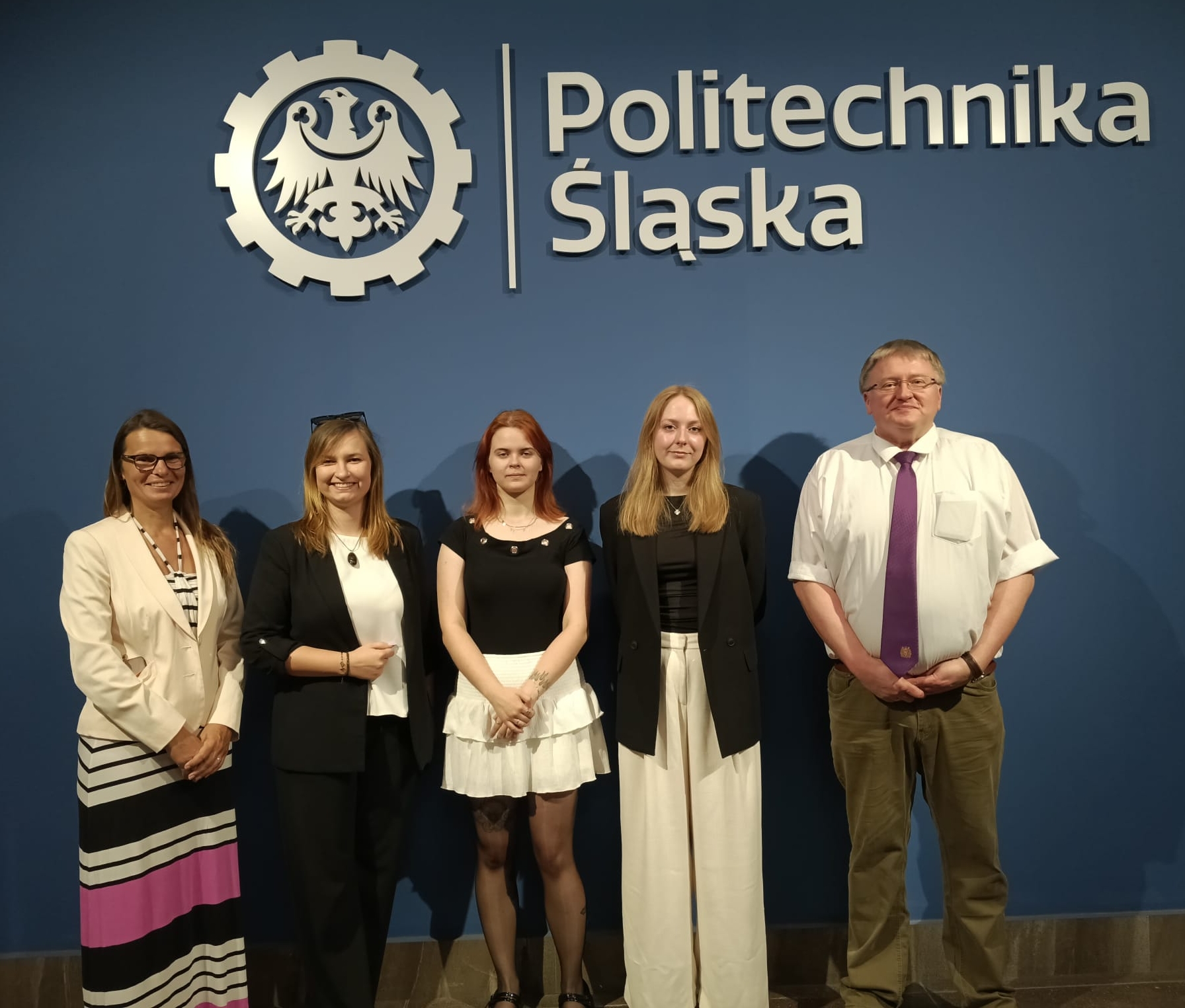
The project was carried out by students from the Silesian University of Technology and Universiti Utara Malaysia. The project team consisted of: Natalia Zaręba and Oliwia Szweda (Surveying and Cartography, Faculty of Mining, Safety Engineering, and Industrial Automation), Piotr Grodzicki (Chemical Technology, Faculty of Chemistry), Aleksandra Rocznik (Engineering Technologies in Forensic Science, Faculty of Biomedical Engineering), Mohd Rahimi Abdul Karim, Zairil Anuar Zulmuji, Putri Safira Bianca Putri (Master of Science in Geoinformatics for Disaster Risk Reduction, School of Computing, Universiti Utara Malaysia).
The head supervisor of the project was PhD Eng Krzysztof Tomiczek, Assist. Prof. at SUT (RG4); the academic supervisors were: PhD Nur Suhaili Mansor, Dep. Direct. at UUM, DSc Aneta Grodzicka, Prof. at SUT (RG4), and PhD Monika Żogała, Assist. Prof. at SUT (RG4).
This is yet another successful project carried out in collaboration with a highly ranked Asian university (UUM – QR: 540 in the World University Ranking).
The project involved the use of satellite maps of flood and landslide hazards, developed using programming and remote sensing tools, and their subsequent transformation into 3D models overlaid on digital elevation models. Particular emphasis was placed on maintaining scientific consistency between the analytical layer and the visualization layer.
The project’s objective was achieved: a clear, proprietary methodological workflow was designed and tested, encompassing the following stages: scanning and analysis of satellite maps, programming processing, generation of hazard maps, their elaboration, conversion to 3D models, and final visualization, including the ability to visualize “hazard” forecasts. This proprietary workflow is repeatable, transparent, and applicable across various research areas. The 3D visualization provides a realistic representation of the scientific results of spatial analyses and enables the clear presentation of these results to audiences who are not specialists in geotechnical engineering, environmental engineering, DRR, or GIS.