



Scientific Seminar at the Institute of Physics, CN-D, entitled: "Ferro- and Antiferroelectricity of ABO3 Perovskites: An Attractive Coexistence of Opposites"
We cordially invite you to a scientific seminar at the Institute of Physics, CN-D.
The paper, titled "Ferro- and Antiferroelectricity of ABO3 Perovskites: An Attractive Coexistence of Opposites," will be presented by Prof. Krystian Roleder from the Faculty of Science and Technology, University of Silesia in Katowice. A summary is below.
Today's world is dominated by so-called nanotechnology, the best visible example of which is the mobile phone and the entire telecommunications sphere. Although this term doesn't make much of an impression on those familiar with the physical sciences, we deal with individual atoms, nuclei, and elementary particles—a world much smaller than "nano." However, reaching these dimensions was undoubtedly a scientific challenge. It's safe to say that if it weren't for the discovery of PbZr1-xTixO3 compounds (known as PZT) in the 1950s, today's nanotechnology would not exist. This was achieved, among other things, thanks to the development of the tunneling microscope and the atomic force microscope in the 1980s, which utilized the excellent piezoelectric properties of PZT ceramics to build actuators that allowed the measuring element in these microscopes (the so-called tip) to be moved over distances corresponding to the size of atoms. Today, PZTs find numerous practical applications in microelectronics (transformers), medicine (ultrasound), sports (skis, sportswear), and even in cars, where they provide improved fuel economy. Although several decades have passed, PZT materials are still being used in the form of ceramics.
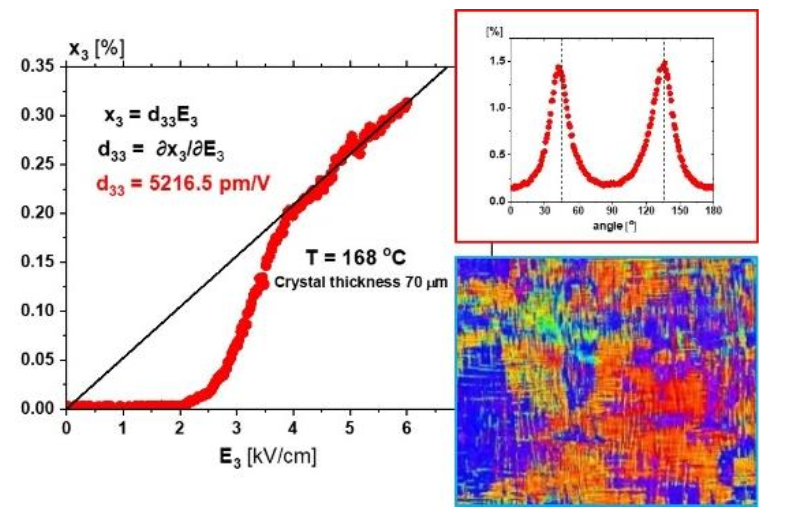
In a sense, it was strange that until recently we did not know the physical mechanism responsible for the strong piezoelectric deformation of PZT perovskites. It was believed that the main cause of the strong deformation was an electric field-induced change in the material's symmetry. For only a few years, we have had the technology to grow PZT crystals with Ti content in a wide range. We observed that these crystals, under the influence of an electric field, undergo deformation of the order of 0.3%, which is sufficient to achieve a piezoelectric effect thousands of times stronger than quartz. Our research showed that this is related to a kind of structural chaos involving the coexistence of phases with different symmetries within a single crystal. I will attempt to convince the audience how this happens at the micro- and nanoscale by presenting the results of our experimental studies in the first part of the presentation.
Besides the practical aspects of our research,3 outlined above, there is also one related to fundamental research. Lead zirconate PbZrO3, a component of PZT and the first antiferroelectric material ever discovered, became the prototype of an antiferroelectric compound. Although this material has been studied for over 70 years, it was only in the last ten years that its extraordinary and unusual physical properties have been discovered, including a complex structural mechanism of phase transition, an unconventional paraelectric phase with polar nano-regions, jumpy domain wall motions, the flexoelectric phenomenon, a large negative electrocaloric effect, and cycloidal polarization order. Just four years ago, it turned out that the antiferroelectric properties of PbZrO3 are not unique, and that this crystal can exhibit ferrielectric (not ferroelectric) properties, which are extremely rare among hundreds of ABO3 perovskites. This was initially suggested by computer simulations, which concluded that ferrielectric (polar) properties should occur below room temperature, thus questioning the existence of a pure antiferroelectric state in PbZrO3 up to absolute zero. I will attempt to convince the audience that the predictions of computer simulations can be intriguing in the second part of my presentation.