



Start - Aktualności - DronBox Mobile Drone Technology Centre presented in Gliwice
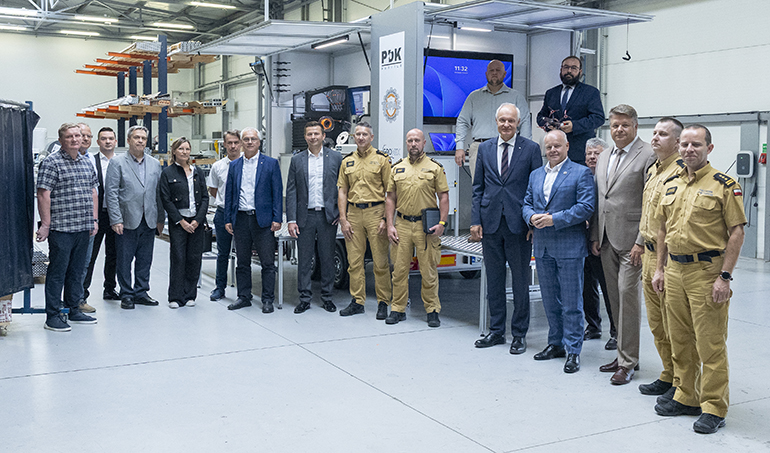
DronBox Mobile Drone Technology Centre presented in Gliwice
An innovative solution combining mobile production, repair, testing, and servicing of drones was presented on August 31st, 2026, in Gliwice. The prototype of the DronBox Mobile Drone Technology Centre was created thanks to the cooperation of scientists from the Silesian University of Technology and Silesian enterprises. DronBox will be presented to the general public for the first time at the International Defence Industry Exhibition in Kielce.
The presentation of the prototype of the Mobile Drone Technology Centre took place on August 31st this year in the PDK Profile hall in Gliwice. The project is the result of cooperation between the TOPAZ Centre for Defence and Dual-Use Technologies of the Silesian University of Technology and three companies: PDK Profile sp. z o.o., Gromex sp. z o.o. sp. k. and ZAMET-GŁOWNO sp. z o.o. sp. k.
– We are showcasing successful cooperation with several Polish companies, but also with uniformed services, including the fire service and the military, in the development of technologies that are currently of particular interest to us – i.e. drone technologies – said Prof. Dr Hab. Eng. Marek Pawełczyk, the Rector of the Silesian University of Technology. – This is precisely why the TOPAZ Centre for Defence and Dual-Use Technologies was established, so that such interdisciplinary projects could be created and respond to real needs.
The Mobile Centre, also known as the Dron Box, was designed as a comprehensive, autonomous technological facility enabling the production, maintenance, repair, and use of various types of multi-rotor drones. The solution also enables reverse engineering, i.e., the reconstruction and repair of elements damaged in the field, the design and manufacture of components using additive technologies and composite materials, as well as drone control. The project has been covered by a patent application, and a pre-premiere demonstration took place yesterday in the presence of representatives of uniformed services that might be interested in using the designed technology in their units.
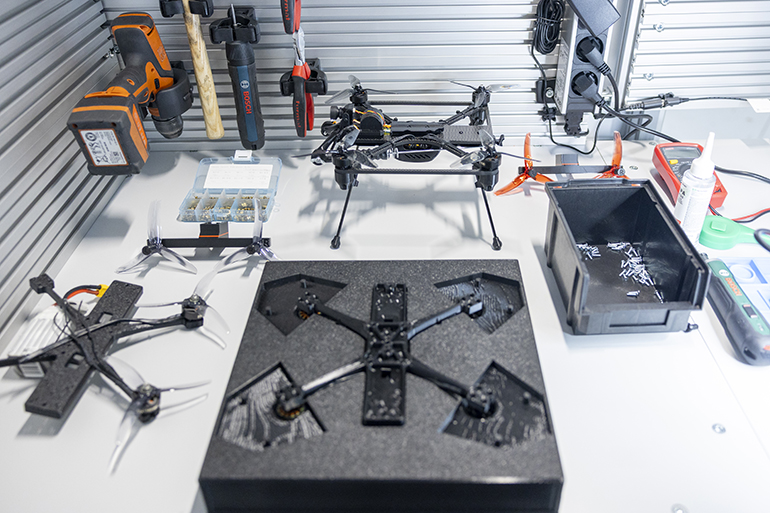
This complex and innovative design looks at first glance like an ordinary trailer. Inside there are several stations that quickly change this first impression. The inconspicuous laboratory houses workspaces enabling, firstly, the design of a selected drone component and its parts to be printed using a 3D printer, secondly, the connection of appropriate electronic equipment to it at a soldering station and then testing and programming so that the drone can perform a special task.
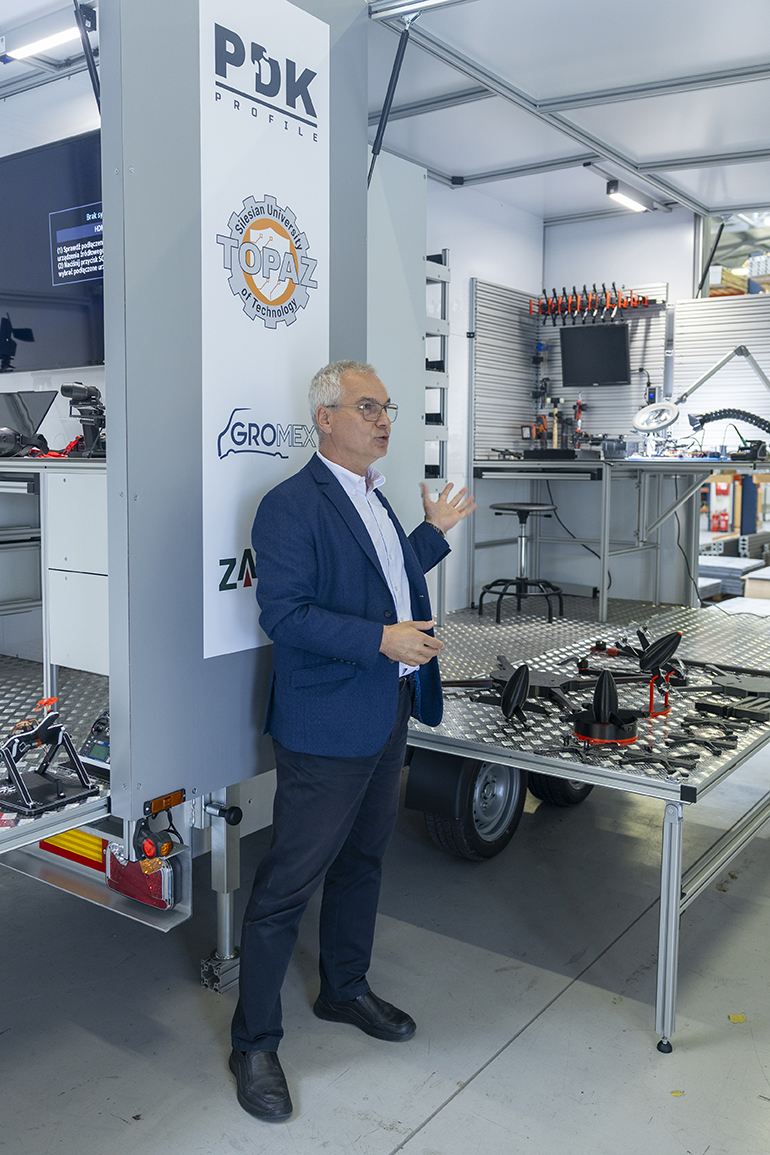
– It is a mobile factory, but also an assembly point, a testing point, and a drone flight management point placed on a single, mobile chassis – emphasizes Prof. Dr. Hab. Eng. Arkadiusz Mężyk, Director of the TOPAZ Centre for Defence and Dual-use Technologies at the Silesian University of Technology. – What is most interesting for us is that we have managed to create a product that we can offer to both the civilian and military markets, as well as to crisis management services. We hope that it will be commercialized very quickly.
– We can produce drones of various sizes and with various technologies, adapting them to the user's particular needs. We can also test them for stability and suitability for performing a safe mission, and then supervise the entire drone mission, notes Prof. Arkadiusz Mężyk.
Drones currently play an important role in military and war operations but are also increasingly used in everyday life by businesses and emergency services.
As emphasized by Dr Adam Mańka from the Faculty of Transport and Aviation Engineering of the Silesian University of Technology, the solution integrates various technologies in one mobile system, which will prove useful in many fields of activity.
- The centre is prepared to design and manufacture various types of drones using 3D printing technology, i.e. additive technologies, using carbon technologies, i.e. milling, working with carbon fibre materials and other technologies, as well as CNC laser cutting - explains Adam Mańka. - We also have a complete database of components, including engines, propellers, flight controllers, and a complete set of cameras and sensors, which the operator can assemble very quickly at the station prepared here, - he adds.
– To sum up, the entire process can take place in the mobile laboratory: from manufacturing, through drone assembly, to its diagnostics and preparation for the mission, up to mission control. This is comprehensive drone service and the ability to support various services in this area – says Dr Eng. Adam Mańka.
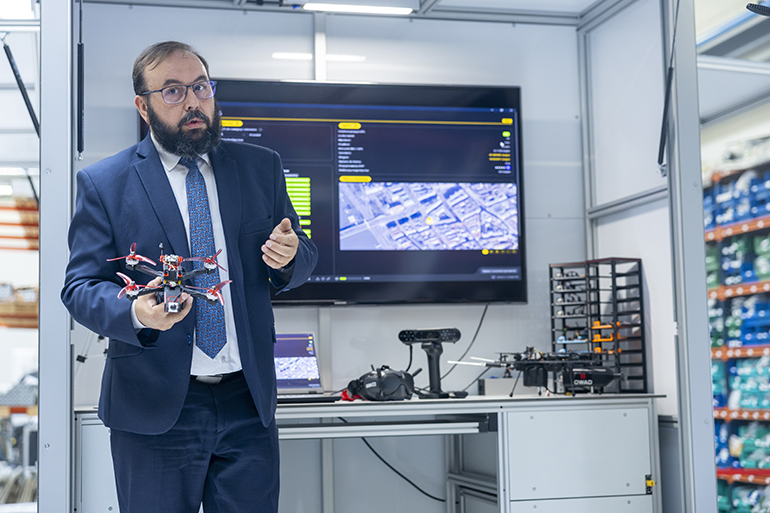
The Mobile Drone Technology Centre is intended primarily for crisis management services, the military, the police, and the Border Guard. It will also be used in the training of specialists in countering drone attacks and in the production of unmanned aerial vehicles adapted to specific user tasks.
A significant advantage of the solution is the ability to quickly repair, modify or restore damaged components without having to replace the entire device. This allows us to reduce operating costs and flexibly adapt structures to changing needs and technological developments.
– Users of this mobile centre do not have to buy new drones for each mission but can repair or replace individual parts. This significantly reduces operating costs and allows the system to be modernized as needed, emphasizes Dr Eng. Adam Mańka.
The mobility of the system is ensured by a 2.4-ton trailer. The centre can be towed by appropriately adapted vehicles, and its configuration can be adapted to the needs of the customer. The structure can also be mounted on the chassis of a delivery vehicle.
- As we heard during the presentation, such a platform is capable of ensuring the production of up to a dozen, maybe even several dozen drones per day. It can operate in difficult conditions, in battlefield conditions. This is a response to the current needs of the country and Europe. The Silesian University of Technology responds to this need very actively - added the Rector of the Silesian University of Technology,
Important features of the solution are operational autonomy, high mobility and the use of components manufactured in Poland and European Union countries.
Prof. Dr Hab. Eng. Marek Gzik, Deputy Minister of Science and Higher Education, emphasized that the Polish army would be interested in this type of solution and supports such scientific and technological projects.
- It is worth emphasizing that this project not only demonstrates excellent Polish technological thought but is also based entirely on Polish materials and those originating from the European Union market - he noted.
- I think that this entire project is primarily inspired by experiences on the front line in today's Ukraine. We see how important a role drone technology plays in the modern theatre of war. In fact, the Russian troops, which were numerically superior in terms of technology, were stopped by Ukraine with this technology, and this gives us an impulse to think and reflect, he added. Prof. Gzik expressed hope that an order from the Polish army and other security institutions is almost certain, as it seems that there is a need to acquire such technology, and the Mobile Centre itself is of high quality.
The project is an example of a practical combination of scientific and industrial competences. The Silesian University of Technology contributed its knowledge and research and development competences to the project, while industrial partners were responsible for the implementation and development of individual elements of the solution.
Marek Dubieński, owner of PDK Profile company, draws attention to the importance of cooperation between businesses and science.
– We are jointly responsible for the entire undertaking. Our contribution is primarily the production and implementation of elements made here, in this production hall. The entire technical and scientific idea was developed with significant participation of the Silesian University of Technology – he emphasizes. – If there is demand, we will produce it. Now it is important to present the solution to potential customers.
The first public presentation of the Mobile Drone Technology Centre will take place during the International Defence Industry Exhibition 2026 in Kielce, which will run from September 8 to 11, 2026.
The project's creators hope that the solution will be of interest to both Polish services responsible for security and crisis management, as well as military and civilian customers from Poland and abroad.
fot. Maciej Mutwil