PBL Project "Key metals for modern defense technologies - an interactive station for identifying these metals and their minerals in augmented reality"
Metals are extremely important in defense, as they form the basis of both traditional weaponry and modern military technologies. Their high mechanical strength, resistance to impacts, explosions, and extreme temperatures make them indispensable in the production of armor for tanks, armored vehicles, ships, aircraft, and missiles. Iron and steel, including special armor steels, play a key role here. Aluminum is widely used in military aviation and drone production due to its lightness and corrosion resistance, while titanium combines low weight with very high strength, which is why it is used in modern aircraft, submarines, and missile components. Metals such as copper, silver, and gold are also essential in military electronics, enabling the operation of communication systems, radars, satellites, and guidance systems. Nickel, cobalt, chromium, and their alloys are used in jet engines and turbines. Gallium, germanium, and lithium are crucial for the development of advanced electronics, energy systems, and modern military technologies. Rare earth metals such as neodymium, dysprosium, and lanthanum are essential for the production of strong magnets, sensors, and advanced electronics used in drones, targeting systems, and precision weapons. Modern defense technologies, such as missile systems, stealth technologies, artificial intelligence, satellite reconnaissance, and cybersecurity, rely heavily on the properties of these metals and their alloys. The durability of metals and their ability to be processed, repaired, and recycled increase the reliability of military equipment in harsh environments, while access to strategic metals directly impacts national security, technological independence, and the ability to develop modern defense systems.
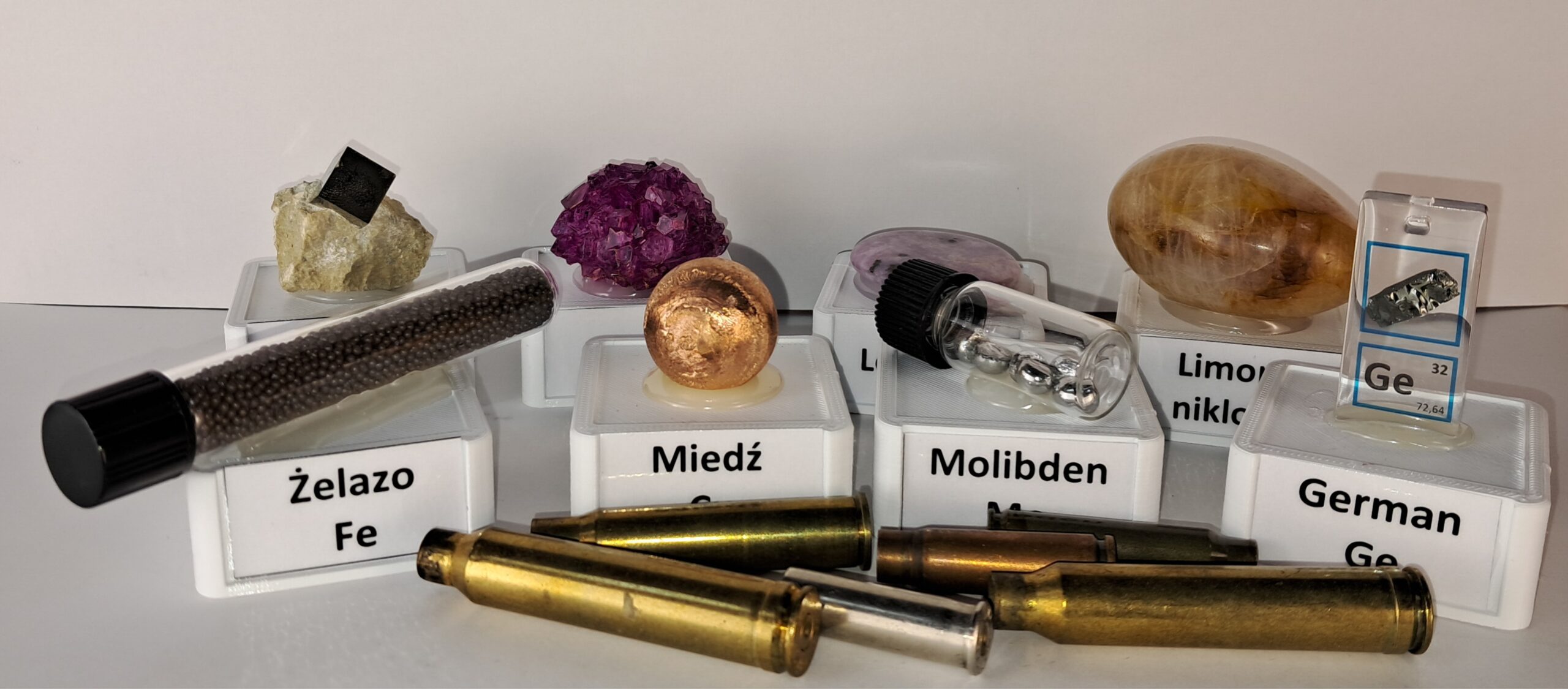
The project aimed to develop and implement a modern teaching station to impart knowledge in the field of mineralogy at the level required for the production and application of metals in modern defense technologies. In addition to providing students with direct contact with the metal or mineralogical material under discussion, this station is equipped with modern IT tools that significantly enhance its functionality with augmented reality. The station is designed as a display case with individual minerals and metals as exhibits. Additionally, a program was developed to display data and images of each mineral and metal. A QR code assigned to the display case transports students to an augmented reality experience containing comprehensive information about the metal itself and its minerals, its importance from the perspective of metallurgy and materials engineering, and the possibilities and methods of its technological use, primarily in defense.
Also available on the website for the Polish and English versions:
https://pblmetale.polsl.pl/PBL2026/
you can learn more about selected minerals and metals as well as selected technologies used in defense.
Made as part of the PBL project "Key metals for modern defense technologies - an interactive station for identifying these metals and their minerals in augmented reality".
Made by:
- Krzysztof Willinger
- Krystian Milowski
- Kamil Kulka
- Maciej Stępień
- Paweł Nagórzański
- Marie Maiková
- Lukáš Vinš
- Szymon Saternus – student of PZS Lędziny (the school has a signed cooperation agreement with the Silesian University of Technology – Faculty of IMiCP)
Supervisors:
- dr hab. inż. Mariola Saternus
- dr hab. inż. Tomasz Merder, prof. PŚ
- Ing. Ladislav Socha, MBA, Ph.D.
The project was supported by students from Škoda Auto Univeristy, Mladá Boleslav, Czech Republic.