Silesian University of Technology Students Develop an Innovative Recycling Method for Cemented Carbide Tools
During the 2025/2026 academic year, a Project-Based Learning (PBL) project entitled “Investigation of Aluminum-Induced Self-Disintegration of WC-Co Materials as an Innovative Recycling Method for Cutting Tools” was carried out at the Faculty of Materials Engineering of the Silesian University of Technology.
The project addressed one of the current challenges in modern materials engineering: the recovery of tungsten and cobalt from worn cemented carbide tools. These elements belong to the group of critical raw materials, whose extraction from primary ores is associated with significant economic and environmental costs. As a result, technologies enabling their efficient recovery and reuse are becoming increasingly important.
Project Objective
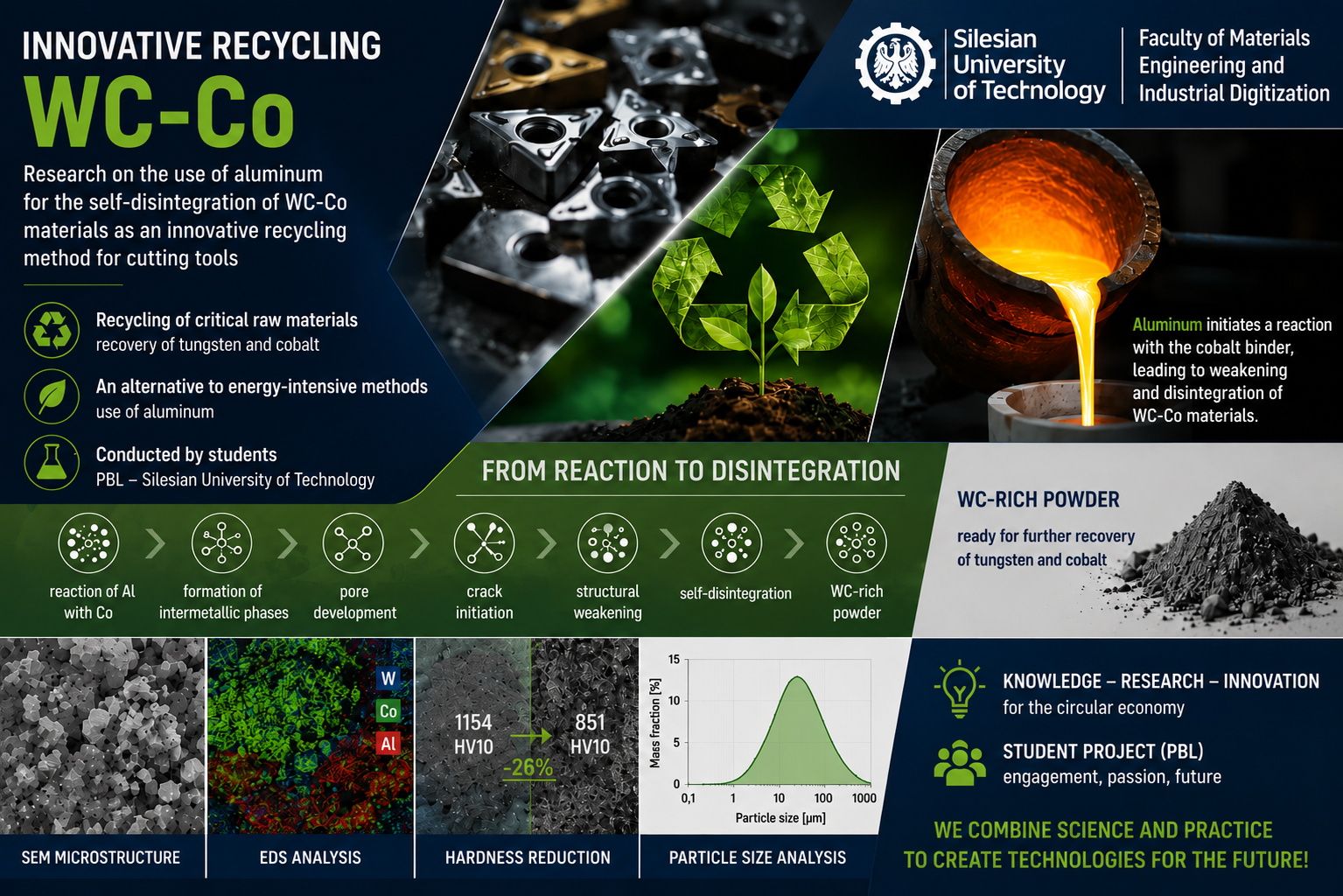
The main objective of the research was to determine whether aluminum could be used to initiate the spontaneous disintegration of WC-Co materials. It was assumed that the reaction between aluminum and the cobalt binder would weaken the material structure, leading to its gradual degradation and ultimately producing a powder rich in tungsten carbide particles.
Scope of the Research
The project included a comprehensive experimental program consisting of:
- preparation of samples with controlled aluminum additions,
- remelting processes conducted under a protective argon atmosphere,
- analysis of mass changes during the aging period,
- microstructural investigations using scanning electron microscopy (SEM),
- chemical composition analysis using energy-dispersive spectroscopy (EDS),
- microhardness measurements,
- particle size distribution analysis of the disintegration products.
These investigations enabled a detailed assessment of the structural changes occurring in the material during successive stages of the degradation process.
Key Findings
The experimental results confirmed that aluminum effectively initiates the degradation process in WC-Co materials. The formation of reaction zones, porosity, and microcracks was observed, leading to a gradual weakening of the material structure.
Microstructural analyses revealed that the primary area of interaction was the cobalt binder responsible for maintaining the integrity of tungsten carbide grains. As a consequence of the ongoing reactions, the material progressively lost its structural cohesion and underwent spontaneous disintegration.
Furthermore, a reduction in hardness of approximately 26% was recorded, confirming the deterioration of the mechanical properties of the material. Granulometric analyses of the disintegration products demonstrated the possibility of obtaining a fine powder enriched in the WC phase.
Development of the Disintegration Mechanism
One of the most significant outcomes of the project was the development of a mechanism describing the spontaneous disintegration of WC-Co materials. The proposed mechanism consists of the following stages:
Reaction of aluminum with the cobalt binder → formation of intermetallic phases → development of porosity → initiation of cracks → structural weakening → spontaneous disintegration → formation of WC-rich powder.
The obtained results provided a deeper understanding of the processes occurring during the interaction of aluminum with tungsten carbide-based tool materials.
Significance of the Project
The research findings indicate that the developed method may represent a promising alternative to conventional cemented carbide recycling technologies. Its main advantage is the possibility of selectively weakening the cobalt binder without the need for energy-intensive mechanical crushing operations.
The project also contributed significantly to the development of students’ research skills and provided valuable experience in advanced materials characterization techniques, critical raw materials recycling, and experimental research methodology.
The obtained results demonstrate the potential of aluminum-assisted disintegration as an innovative approach to the sustainable recovery of tungsten and cobalt, supporting the principles of the circular economy and resource-efficient materials engineering.
Made by:
- Piotr Kaczmarek
- Wojciech Jarosz
- Paweł Pelka
- Tomasz Żorawik
- Robert Frola
- David Molla
Supervisors:
- dr inż. Tomasz Matuła
- dr hab. inż. Jarosław Piątkowski, prof. PŚ
- dr hab. inż. Katarzyna Nowińska, prof. PŚ
- Dr.-Ing. Alphonce Wikedzi