




The comprehensive evaluation of thermoelectric sub-cooling solution combined with the state-of-the-art ejector-based refrigeration cycle for food chain reduction
Registration number: 20214/43/D/ST8/02631
Contract number: UMO-20214/43/D/ST8/02631
Total budget: 706 990,00 PLN
Abstract:
The objective of the project
Minimizing losses in the food chain is essential to reduce the global and local problem of food waste. This design goal is especially important during phasing out of synthetic refrigerants and introducing low-impact working fluids into all refrigeration systems. For this reason, the aim of SubCoolJet is investigate the flow behaviour, the thermodynamic and the heat transfer effects of the thermoelectric sub-cooling solution integration together with the ejector-based refrigeration cycle using of environmentally friendly natural working fluids for food chain reduction. The liquid sub-cooling process of the refrigerant inside the vapour compression cycle using thermoelectric modules (TEM), such as the Peltier modules, allows for smooth capacity control and significant energy performance improvement of the state-of–the-art ejector-based cycles.
Research motivation
The global awareness related to the global warming impact on the environment and climate change forces all of us to find new effective solutions and significantly improve the environment impact of each sector. The recent regulations regarding the phase-out of all fluorocarbon (FC), chlorofluorocarbon (CFC) and hydrochlorofluorocarbon (HCFC) based refrigerants phase-out from the market resulting in most hydrofluorocarbons (HFC) are difficult to apply or banned in Europe. Therefore, the only safe and necessary solution in the food industry and to reduce losses in the food chain is to use natural refrigerants, i.e., R744 and hydrocarbons either a pure single working fluid or mixture between them due to thermodynamic properties, availability and no negative impact on the environment. Although to maintain a high system energy performance (COP) in low- and high-temperature areas, it is required to use state-of-the-art technologies in the refrigeration system, which can be done by an integration of the ejector technology together with the thermoelectric sub-cooling solution.
A principal idea is to integrate thermoelectric sub-cooling unit together with the ejector-based refrigeration cycle using natural-based refrigerants, which will be never phased-out due to the negative impact to the environment. The main aim of the ejector in such a vapour compression rack is to recover an expansion work that results in higher efficiency of the whole system (even by 25%) and reduce the pressure ratio in the compressor resulting lower total power consumption. The benefits of the sub-cooling solution integration together with ejector-based refrigeration for natural-based working fluids can be defined as follows: (a) energy performance improvement for cooling (2°C÷8°C), low-temperature freezing (up to -25°C), and ultra-low temperature freezing (below -25°C) processes; (b) energy performance improvement for heating process, e.g. heat pumps and food dehydration; (c) cooling and heating capacities control of the fixed-type ejector for system optimisation at small, medium, and large-scales of refrigeration units; (d) operational envelope extension due to the flooded evaporator and R744-R1270 binary mixture, especially at low-freezing and ultra-low freezing processes; (e) a use of the unlimited natural-based working fluids with no impact on the global warming effect, ozone depletion process, human health, and the ground water poisoning.
According to the literature review, the combined solution of the ejector technology together with the sub-cooling TEM solution was investigated based only on the theoretical analysis. However, both solutions used for R744 let to improve system COP even by 39% for food storage process at high ambient temperature above 40°C [14]. Therefore, the integration of TEMs with the ejector technology allows for high COP improvement maintenance, optimum system control, and system compactness, which has to be deeply investigated using advanced numerical and experimental investigations that is in line with the environment protection policy.
Project description
The project will be performed through the numerical simulation and experimental research. The project work plan is divided into four research tasks:
- Development of the computational fluid dynamics approach of the liquid sub-cooling process coupled with the 1-D electromagnetic numerical model of the Peltier module;
- Experimental analysis of the liquid sub-cooling solution work inside the CO2 (R744) ejector-based supermarket refrigeration unit for food freezing;
- Experimental investigation of the propane (R290) ejector-based small-scale heat pump unit capacity control using liquid sub-cooling solution;
- Experimental analysis of the sub-cooling ejector-based refrigeration unit using natural working fluids blends CO2 and propylene (R1270) for performance improvement at small-scale solutions.
Implementation of project objectives:
The project completed the following detailed research tasks and achieved the following key results:
- A numerical model was developed to study the thermoelectric subcooling process of any working fluid, particularly for natural refrigerants such as CO2, propane, or mixtures. The numerical model was based on coupling independent computational fluid dynamics (CFD) models of heat exchangers with an electrical model of the thermoelectric module's operation. The developed model allowed for the study of various shapes of refrigerant flow channels, which contributed to expanding the research to include implementation methods based on standard solutions and 3-D printing.
- A test bench for thermoelectric liquid subcooling was designed and built, enabling integration with any refrigeration system. Experimental studies demonstrated the beneficial effect of using a thermoelectric liquid subcooler to control the performance of a two-phase ejector by changing the thermodynamic parameters at the ejector inlet due to the power supply to the thermoelectric modules. As a result, the proposed method allowed for a change in ejector performance by over 10%, and the energy efficiency (COP) and cooling capacity of the system were improved by over 5% and 20%, respectively.
- A test bench for a refrigeration system using CO2 and a CO2-hydrocarbon mixture was designed and built to test the effect of thermoelectric liquid subcooling on the operation of the refrigeration system and heat pump. Experimental studies demonstrated an improvement in COP of over 11% using a thermoelectric liquid subcooler operating at the optimal supply voltage to the thermoelectric modules.
- The project also provided valuable data on the feasibility of using thermoelectric liquid subcooling in a small-scale propane heat pump. As a result of using the 3-D printing method, the efficiency of the liquid subcooler, and therefore the COP of the R290 heat pump system, was improved by over 6% compared to a conventional heat pump, enabling further development of thermoelectric liquid subcooler applications.
The project thus provided valuable data necessary for understanding the processes of heat transfer intensification through the operation of thermoelectric modules, as well as the possibility of using two-phase ejectors to control the performance of CO2 systems, data that had not previously been found in the available literature. This data is widely anticipated by all researchers working on improving the energy efficiency of refrigeration systems and designing high-performance heat exchangers. In this way, although in a slightly longer time perspective, the reported project may accelerate progress in the use of thermoelectric subcoolers, but also stimulate the development of air conditioning systems based on natural working fluids in mobile and stationary applications, heat pumps, and refrigeration devices.
The SubCoolJet project was carried out in collaboration with research teams from the University of Jaume I (Spain), the Public University of Navarra (Spain), and the University of Udine (Italy).
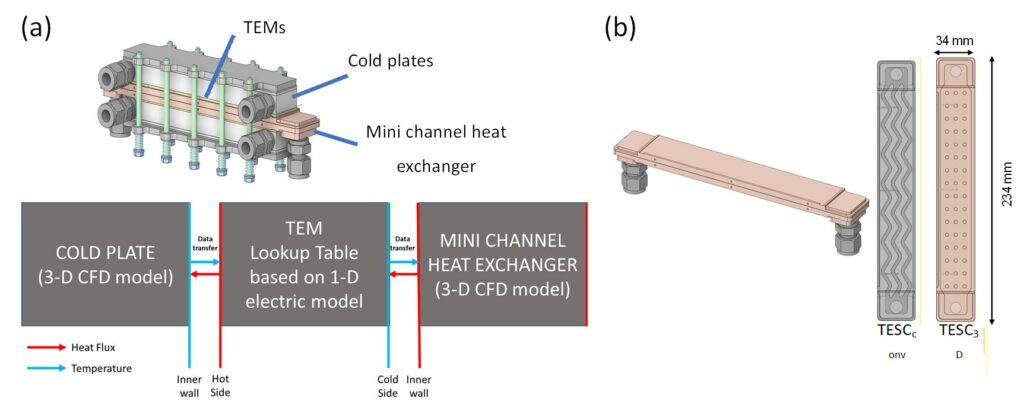
Fig.1. Coupled numerical model scheme (a) and an example of a different thermoelectric subcooler design (b).
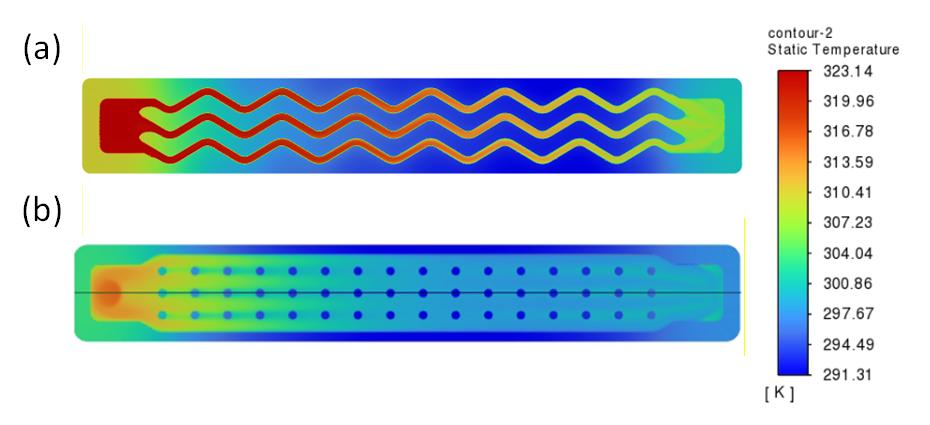
Fig.2. The temperature contour plot of two different shapes of the thermoelectric subcooler.
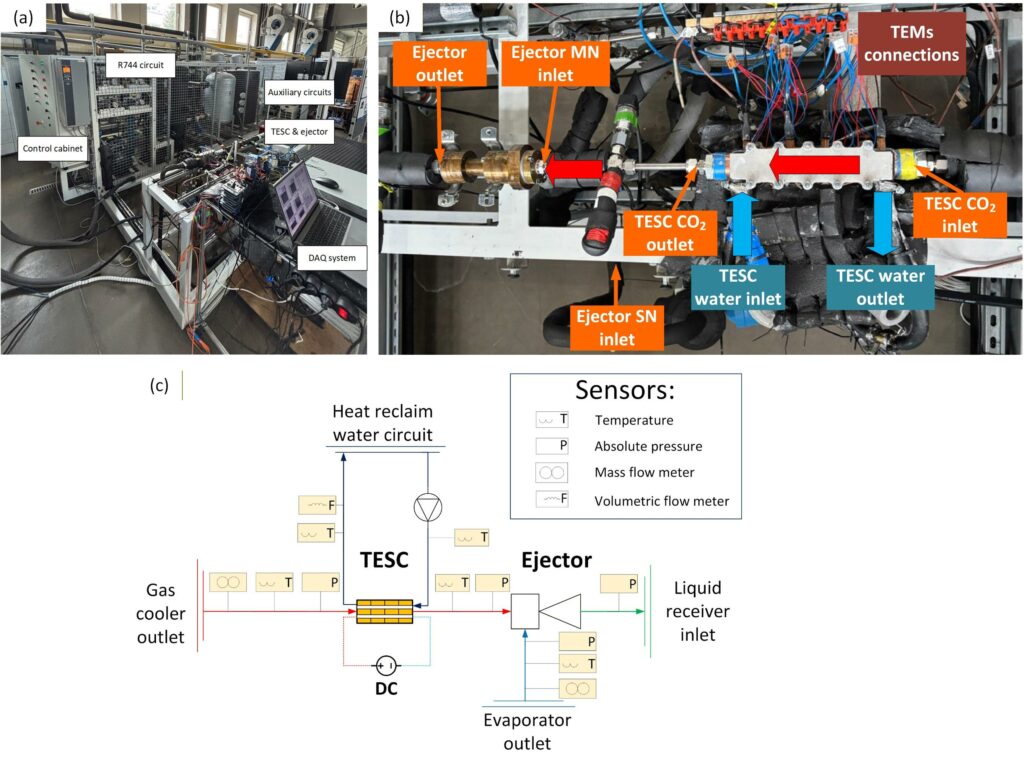
Fig.3. The CO2 refrigeration unit (a) and an integration of a test bench for thermoelectric subcooling at the inlet of the two-phase ejector (b).
Scientific papers:
- Aranguren, D. Sánchez, M. Haida, J. Smolka, R. Cabello, A. Rodríguez, D. Astrain, Effect of thermoelectric subcooling on COP and energy consumption of a propane heat pump, Applied Thermal Engineering, 257, 2024. Otwarty dostęp: https://doi.org/10.1016/j.applthermaleng.2024.124242
- Pendzialek, T. Özyıldız, R. Fingas, D. Sánchez, P. Aranguren, J. Smolka, M. Haida, Experimental investigation of a R290 domestic heat pump equipped with a thermoelectric-aided sub-cooler, Results in Engineering, 26, 2025, Otwarty dostęp: https://doi.org/10.1016/j.rineng.2025.105237
- Özyıldız, M. Haida, J. Smolka, D. Sánchez, R. Fingas, E. Sicco, P. Aranguren, Performance mapping of the thermoelectric subcooler devoted to domestic heat pump applications, 348, 2026. https://doi.org/10.1016/j.enconman.2025.120656
Data available in OA repository:
- Patricia Aranguren, Daniel Sánchez García-Vacas, Michal Haida, Jacek Smolka, Ramon Cabello, Antonio Rodriguez, David Astrain, Effect of thermoelectric subcooling on COP and energy consumption of a propane heat pump, Mendeley Data, 2025, DOI: 10.17632/bd8kbwrmtw.1, https://data.mendeley.com/datasets/bd8kbwrmtw/1
- Michał Pendziałek, Michal Haida, Tufan Özyıldız, Rafal Fingas, Jacek Smolka, Patricia Aranguren, Daniel Sanchez, The experimental data of the propane heat pump equipped with the thermoelectric-aided sub-cooler, Mendeley Data, 2025, DOI: 10.17632/ys9nxb332x.1, https://data.mendeley.com/datasets/ys9nxb332x/1
- Tufan Özyıldız, Michal Haida, Jacek Smolka, Daniel Sanchez, Rafal Fingas, Emanuele Sicco, Patricia Aranguren, The experimental data of performance mapping of propane thermoelectric sub-cooler, Mendeley Data, 2025, DOI: 10.17632/9dy7sxyh46.1, https://data.mendeley.com/datasets/9dy7sxyh46/1



 +48-32-237-28-10
Research cooperation