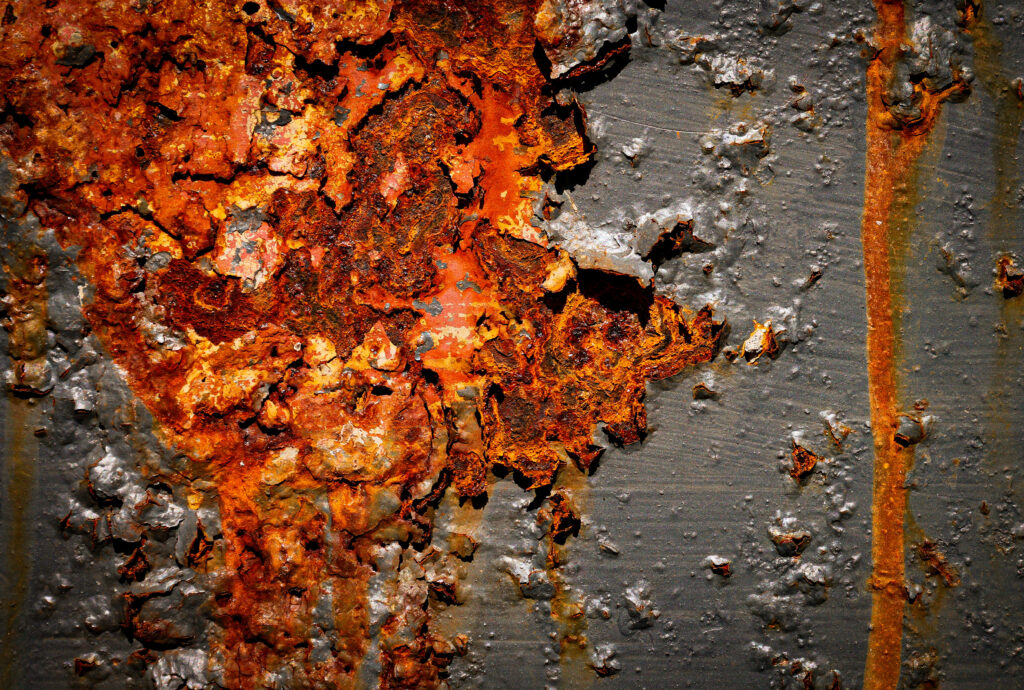
The photograph depicts an advanced stage of corrosion of a metallic surface, resulting from long-term exposure to environmental factors and electrochemical processes. Visible flaking of the coating, material loss, and an irregular structure testify to progressive degradation, leading to a weakening of the metal’s mechanical properties.
Corrosion is a common and inevitable phenomenon that significantly affects the functioning of society. It impacts transportation and industrial infrastructure as well as everyday objects, generating enormous costs related to repair, maintenance, and replacement of damaged components. The macro-scale view shown in the photograph presents a fragment of a structure—most likely part of technical infrastructure—which, as a result of ongoing material degradation, has lost its original properties and functionality. It thus becomes an example of how corrosion can lead to the “decommissioning” of elements of the world around us. This component, which once served a specific utilitarian function, today stands as a testament to the passage of time and physicochemical processes. Global losses caused by corrosion are estimated to reach several percent of the world’s GDP, making it one of the most serious technical problems of the modern world.
From a physical perspective, this process can be interpreted as the system’s tendency toward a state of lower free energy, accompanied by an increase in entropy—a measure of disorder. The metal returns to a more stable chemical form, forming oxides and corrosion products that alter its structure and properties.
Despite its destructive nature, corrosion also reveals a less obvious aesthetic dimension. The resulting structures form complex, almost painterly compositions that can be perceived as a form of natural expression of matter. In this view, the process of destruction simultaneously becomes a process of creation—showing that beauty may arise from transformations we typically regard as undesirable. Corrosion is therefore not merely an act of destruction, but also a record of a material’s history—a trace of its use, environmental interactions, and the passage of time.