




III PRIZE
Natalia Rycerz - Artystka rdzy (The Rust Artist)
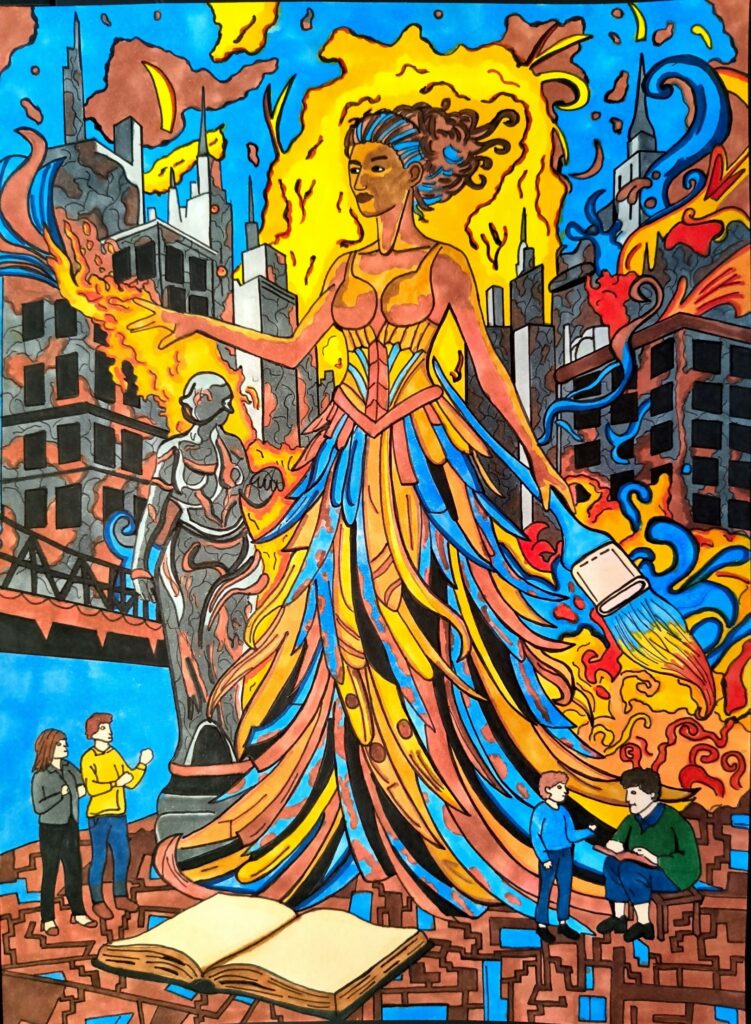
My work presents corrosion not as ordinary metal degradation, but as a process that gives the world new, intriguing colors. I wanted to show that rusting has an artistic dimension and does not always have to be perceived solely as something negative.
At the center of the composition, I depicted a woman who personifies corrosion. Her body and dress are made of elements resembling metal and sheet steel. In her hand, she holds a paintbrush with which she applies new colors to the world. Rust, usually associated with something ugly or undesirable, in reality creates a variety of patterns and colors on metal surfaces. This shows that corrosion acts somewhat like an artist, as it transforms the appearance of gray, steel buildings. The figure uses orange and yellow hues reminiscent of rust, as well as blue tones similar to copper patina. In the drawing, tall buildings and a bridge are visible. I included them to emphasize how important corrosion is in our everyday lives. It affects the safety of bridges we walk across and buildings in which we live. We must understand how to care for metal structures so that they can serve us for as long as possible.
In my work, corrosion is not portrayed unequivocally as a negative phenomenon. On one hand, we see its impact on cities, where buildings bear traces of wear, metal elements undergo transformation, and structures lose their original form. These are real socio‑technical problems involving repair costs, safety risks, and the everyday lives of people. Corrosion weakens structures, requires the involvement of specialists, and generates enormous financial expenditures. It is a process that cannot be ignored. On the other hand, I present corrosion as an artist—as someone who “paints” the city. Rust creates unique textures, colors, and patterns on surfaces. Corrosion does not have to be only a process of destruction; it can also be a process that is aesthetically compelling.
In the lower part of the work, I depicted people of different ages, showing that the problem of corrosion affects everyone. On the left, adults are discussing what is happening to their surroundings. On the right, a child and an elderly person are shown reading an open book together. This illustrates that knowledge about how nature works should be passed from generation to generation. The large book in the center symbolizes knowledge and the need for education about these processes. Only through such understanding is it possible to limit the negative effects of corrosion, design more durable structures, and ensure public safety.
My work therefore presents two faces of corrosion: threat and beauty. On one hand, it is a destructive process that causes real danger and losses. On the other, it is a natural transformation of materials that can produce interesting visual effects. The Rust Artist encourages viewers to look at this phenomenon in a broader way—not only as a problem, but also as an element of the world that can be better understood and controlled. I wanted to show that a process usually associated with destruction can become a source of reflection and art.