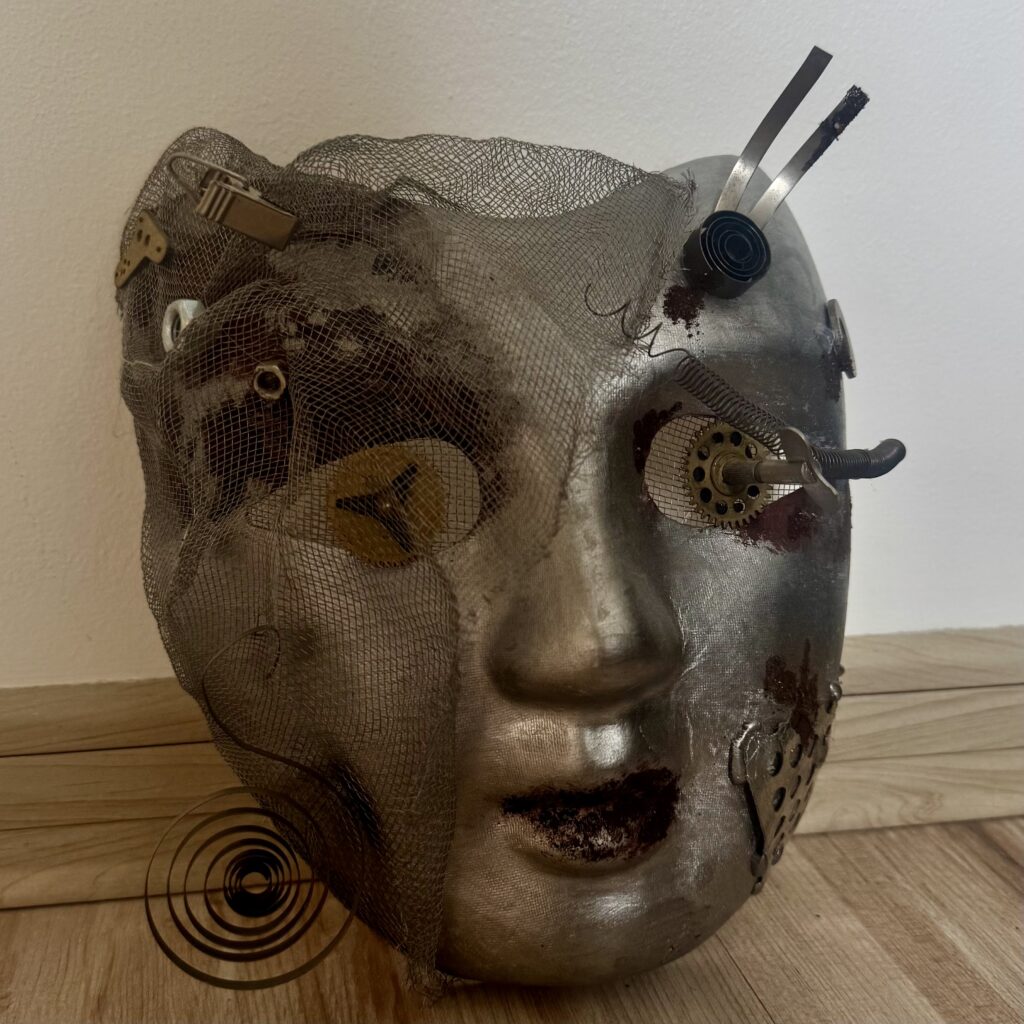
In an abandoned workshop on the edge of a forgotten city, where time is measured by the thickness of settling dust, it lay upon an oak workbench. A silvery mask with features so perfect that it seemed dreamt up by someone who had long forgotten what human skin looks like.
Yet it was not a lifeless piece of metal. It was an arena of struggle.
It began with the lips. The first speck of corrosion appeared at the corner of the mouth like a dark whisper. Oxygen— invisible and merciless— began patiently consuming the gleaming surface, turning cold steel into porous, brittle tissue. Rust was not destroying the mask; it was feeding it with new life. Brown and crimson blooms spread around the lips, forming a gag of iron oxide that forever imprisoned unspoken words. The mask now looked as if it were bleeding dust, as if its metallic heart could no longer bear the weight of centuries.
The right side of the face became a construction site of mechanical chaos. In the empty eye socket, instead of a pupil, sat a rusted gear. Its teeth, once precise and sharp, were now dulled by a reddish deposit. Nearby, a steel mesh— torn and rough— veiled the face like a shroud of the old world. Each opening in the mesh was a trap for light, and every spring embedded in the temple or lying lifeless at the base was proof of lost energy.
The mask stared into nothingness with one mechanical eye, imprisoned beneath an armor of patina. It was a symbol of a hybrid that sought eternity and became an archaeological remnant instead. In the silence of the workshop, one could almost hear a faint crackling—the metal, yielding to entropy, slowly crumbling and falling onto the wooden boards, returning to the earth from which it had been torn.
It was no longer a machine. It was no longer human. It became a pure process — beauty hidden within a slow, rust‑colored death.